
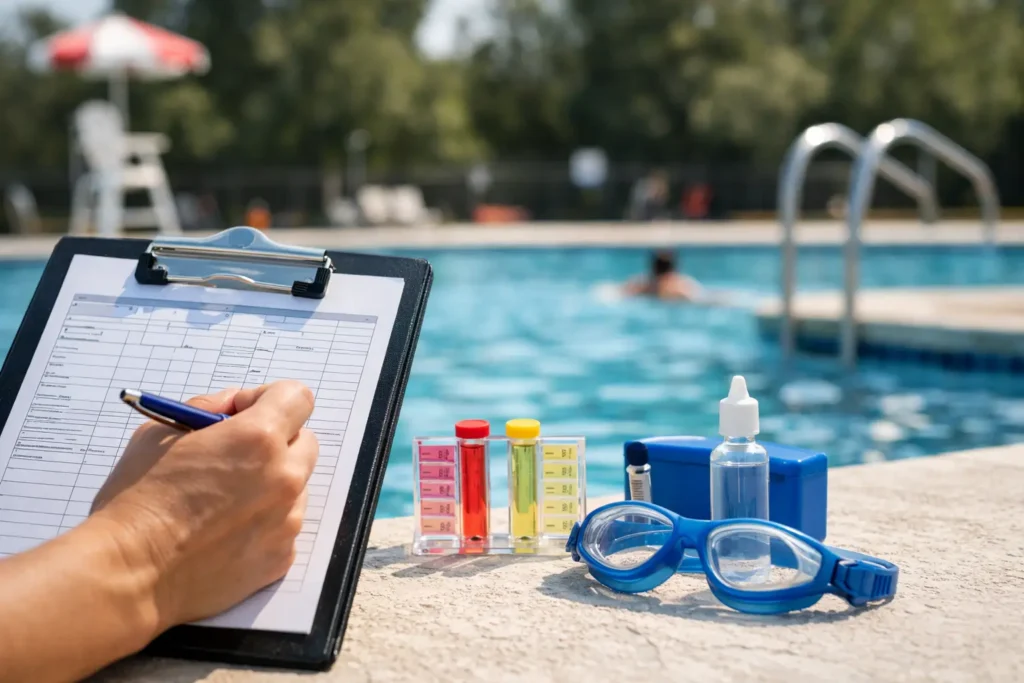
A health inspector asks for your operating log, and the binder is missing three days of readings. The water may look clear, but that is not the standard an inspector, property owner, or public health department uses to judge safe operation. Pool log requirements create a written record that the facility was monitored, problems were recognized, and corrective action was taken.
For public and commercial pools, the log is more than paperwork. It is evidence of daily operational control. Hotels, apartment communities, gyms, HOAs, schools, and recreation facilities all need a system that makes required readings easy to perform, record, review, and retrieve. The specific rules vary by state, county, and local health department, so your local code always controls. Still, the same core records appear in most jurisdictions.
What Are Pool Log Requirements?
Pool log requirements are the records a regulated aquatic facility must maintain to show it is operating within required health and safety standards. Depending on the jurisdiction, the health department may require logs to be kept at the pool, available to staff, and retained for a stated period after the entries are made.
Most codes focus on the conditions that directly affect bather safety: disinfectant residual, pH, water clarity, circulation, temperature where applicable, and response to incidents or equipment failures. A log may also document inspections of safety equipment, restroom conditions, enclosure gates, chemical inventories, and backwashing.
Do not assume a generic daily checklist meets your facility’s obligations. A county may require readings at opening and closing, while another may require them at specified intervals throughout the day. Some jurisdictions establish extra testing requirements for spas, high-bather-load pools, water features, or facilities using secondary disinfection. Start with your permit conditions and local code, then build a log that meets or exceeds them.
The Information Your Pool Log Should Capture
A useful operating log answers four questions: What was tested? When was it tested? Who tested it? What did the operator do if a reading was out of range?
At a minimum, most public pool logs should include these distinct details:
- Date, exact time of each test, pool or spa identification, and the name or initials of the person performing it.
- Free available chlorine or bromine residual, pH, and any other chemistry values required by the local authority having jurisdiction.
- Water temperature, especially for spas or heated pools, plus clarity observations and required circulation or flow readings.
- Corrective actions for low disinfectant, improper pH, cloudy water, equipment alarms, contamination events, closures, and reopening decisions.
- A record of chemical additions, filter backwashing or cleaning, maintenance issues, and service calls when local rules or facility procedures require them.
The details matter. Writing “chlorine OK” does not prove the required residual was present. Record the actual test result and the unit used by your local code. A log entry such as “10:15 a.m. – free chlorine 2.5 ppm, pH 7.4, water clear – JS” is specific, traceable, and useful. If free chlorine was 0.5 ppm and the operator added sanitizer, the record should state the reading, action, retest result, and whether the pool was closed during correction.
Include Corrective Actions, Not Just Test Results
A pool log that only records acceptable readings can look incomplete when something goes wrong. Equipment does fail. Heavy use affects water balance. Chemical feeders empty, breakers trip, and weather can change water conditions quickly. The goal is not to suggest that problems never happen. The goal is to show that staff recognized and managed them correctly.
For example, if the disinfectant residual falls below the minimum, document the time discovered, the reading, the closure or restricted-use decision, chemicals added or equipment adjusted, the retest time, and the compliant result before reopening. If cloudy water prevents the main drain from being clearly visible, record the closure and the steps taken to restore clarity. This protects bathers first and gives management a defensible operational history.
How Often Should Operators Complete Pool Logs?
There is no single nationwide frequency. Many public pool codes require chemistry checks at least daily, often before opening and at additional intervals while bathers are present. Spas frequently require more frequent testing because their warm water, smaller volume, and heavier contaminant load can change sanitizer and pH levels fast.
Follow the strictest applicable requirement: your state code, county or city health department rule, operating permit, manufacturer guidance, and facility policy. A property management company may set a higher internal standard than the minimum code, particularly for busy facilities or sites without full-time aquatic staff.
Testing frequency should also increase when conditions change. After a large bather load, a rain event, a chemical adjustment, a feeder malfunction, or a contamination incident, additional testing is practical even if the scheduled check is not yet due. A log is most valuable when it reflects actual conditions, not when it becomes a rushed end-of-shift task.
Manual Logs, Digital Logs, and Automated Controllers
Paper logs remain common because they are simple, inexpensive, and easy for an inspector to review on site. They work well when staff are trained to write legibly, complete every field, and store finished pages securely.
Digital logs can improve consistency for multi-property operators. They can time-stamp entries, flag missed readings, standardize corrective-action notes, and make records easier for managers to review. But a digital system is only useful if staff can access it during a network outage and produce the required records during an inspection.
Automated chemical controllers and remote monitoring systems provide valuable data, but they do not automatically replace manual testing or a required operating log. Sensors need calibration, probes can drift, and local regulations may still require a qualified operator to perform and document manual tests. Treat automation as another operational tool, not a reason to stop verifying water chemistry.
Common Pool Log Mistakes That Create Inspection Problems
The most common mistake is filling in readings later from memory. Entries should be made at the time of testing. Backfilled logs are easy to spot when handwriting, ink, times, and readings appear too uniform, and they are not reliable records of safe operation.
Another problem is recording a number without documenting the response to an out-of-range condition. Inspectors want to see that the operator understood the result and followed the correct procedure. A third issue is using abbreviations that only one employee understands. Keep terminology consistent so another operator, manager, or inspector can follow the record without guessing.
Incomplete identification is also a frequent weakness. If a facility has multiple bodies of water, each entry should clearly identify the specific pool, wading pool, or spa. A single reading labeled “pool” does not establish that every permitted body of water was tested.
Finally, keep logs where they can be found. A completed binder left in an off-site office, a phone app that only one former employee can access, or loose sheets scattered across a maintenance room can turn a compliant operation into an inspection headache.
Build a Log Process Your Team Will Actually Follow
The best log format is the one your team can complete accurately every shift. Place the approved test kit, log, operating procedures, and a working pen or charged device in the same designated location. Make the expected testing times part of the opening, mid-shift, and closing routine rather than an optional maintenance task.
Supervisors should review entries regularly, not only when an inspection is expected. A quick review can reveal recurring low sanitizer readings, rising pH, repeated equipment alerts, or training gaps before they become closures or violations. It also gives newer staff a chance to ask practical questions about what to do when a result falls outside the operating range.
CPO certification training helps operators connect the numbers on a log to the water chemistry, circulation, safety procedures, and corrective actions behind them. That connection is what turns recordkeeping into competent pool operation.
Your log should make one thing clear to anyone who reviews it: this facility is actively monitored by people who know what the readings mean and act when they need to. That is the standard worth building into every shift.