
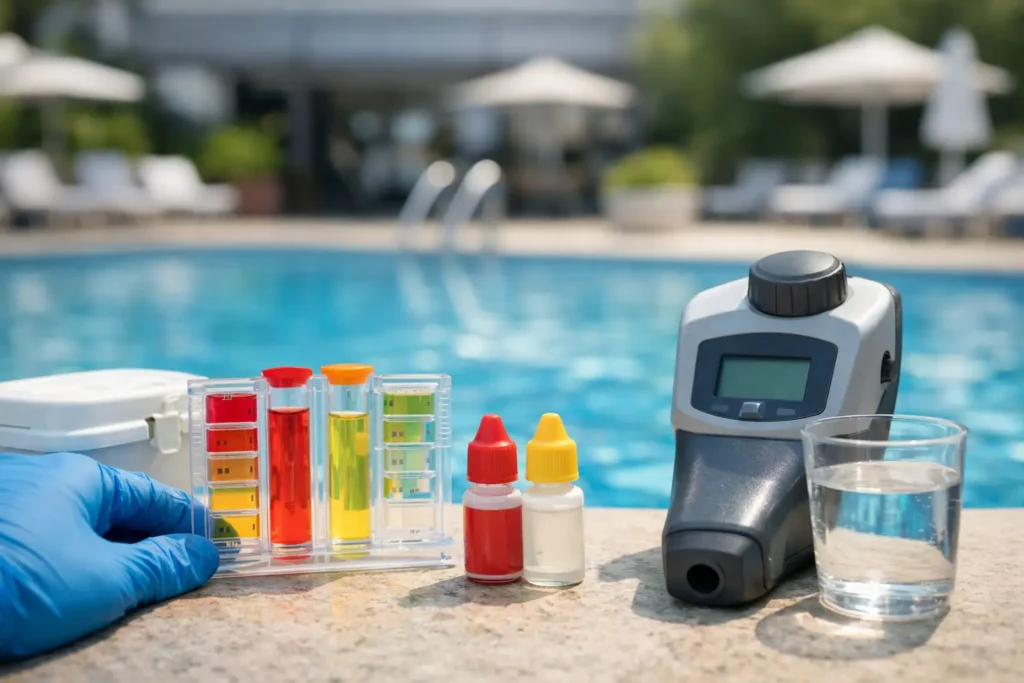
A clear pool can still be unsafe. Chlorine may be low, pH may be outside the usable range, or cyanuric acid may be quietly reducing sanitizer effectiveness. For commercial operators, commercial pool chemical testing procedures are not a paperwork exercise. They are the routine that protects bathers, supports health-department compliance, and tells you when the water needs action before a small issue becomes a closure.
Most public-pool codes establish minimum testing frequencies and acceptable ranges, but the exact requirements vary by state and local health department. Your facility’s operating permit, local code, and manufacturer instructions should always control. A Certified Pool/Spa Operator should understand the reason behind each reading, not just write a number in a log.
Start With a Consistent Testing Routine
Test water at the same points in the circulation system each time. Collect a sample from the pool or spa well away from return inlets, skimmers, chemical feeders, and bather activity. A common field practice is to take the sample about 12 to 18 inches below the surface. This provides a more representative reading than dipping a comparator at the waterline.
Use a clean sample cell or container, rinse it with pool water before collecting the sample, and avoid touching the inside surfaces. Sunscreen, hand lotion, residual reagents, or tap water can affect a result. Test promptly after collecting the sample. Do not let it sit in direct sun or in a hot equipment room while you complete other tasks.
A disciplined routine also means testing often enough. Many jurisdictions require disinfectant and pH checks at least several times per day for public pools, with more frequent checks during heavy use. Spas generally require closer attention because their small water volume, high temperature, and concentrated bather load can change chemistry quickly. Rain, a busy weekend, a fecal or vomit incident, chemical additions, equipment failures, and visible water changes are all reasons to test again outside the normal schedule.
Commercial Pool Chemical Testing Procedures: What to Test
A complete program includes daily operational tests and periodic balance tests. The required panel depends on your local code, the sanitizer used, whether the pool is indoors or outdoors, and the facility’s equipment. Do not assume one test kit covers every compliance requirement.
Free Chlorine or Bromine
Free chlorine is the active sanitizer available to control microorganisms. For bromine pools or spas, test bromine according to the product and code requirements. Combined chlorine, often called chloramines, should also be checked when using chlorine because elevated combined chlorine can indicate inadequate oxidation, high bather waste, or a sanitizer-demand problem.
A DPD test kit is widely used for routine field testing. Follow the kit’s stated order of reagents and read the color within the specified time window. If the sample immediately bleaches out or produces an unexpectedly low reading, do not assume the chlorine is absent. High sanitizer concentrations can bleach some DPD tests. Use the kit’s high-range procedure, a dilution method approved by the manufacturer, or another appropriate test method.
pH and Total Alkalinity
pH affects sanitizer performance, swimmer comfort, corrosion risk, and scale formation. A pH result is only useful when the comparator is clean and the sample is read correctly. When chlorine is unusually high, it can interfere with some pH tests, so follow your test-kit instructions.
Total alkalinity acts as a buffer against rapid pH movement. It is not usually a multiple-times-per-day test, but it should be checked regularly and whenever pH becomes difficult to control. Low alkalinity can lead to unstable pH. Excessive alkalinity can make pH correction difficult and contribute to scaling conditions.
Stabilizer, Calcium, and Other Balance Factors
For outdoor pools using stabilized chlorine, cyanuric acid should be tested on the schedule required by your jurisdiction and whenever chlorine performance is questionable. Too little stabilizer leaves chlorine more vulnerable to sunlight. Too much can slow sanitizer activity and may require a partial drain and refill, subject to local rules.
Calcium hardness, temperature, total dissolved solids, and saturation balance also deserve regular attention. These readings help operators prevent aggressive water that damages plaster, metal, heaters, and equipment, as well as scale that restricts flow and impairs heat transfer. They may not change as fast as free chlorine and pH, but they matter to the long-term condition of the facility.
Use the Right Test Method and Protect Its Accuracy
Commercial facilities should use a reliable, code-accepted testing method capable of measuring the ranges required for that body of water. Basic visual strips can be useful as a quick screening tool, but they are often not precise enough to serve as the only method for a public or commercial pool. A quality DPD comparator, drop-count titration kit, photometer, or digital colorimeter can provide more actionable results when used correctly.
Reagents have a shelf life. Store them sealed, upright, and away from heat, freezing conditions, and direct sunlight. Replace expired reagents and any bottles that are discolored, crystallized, leaking, or difficult to dispense. Mark the date when a new kit or reagent set enters service. A bad reagent can create a false sense of compliance, which is worse than having no result at all.
Staff consistency matters as much as equipment. Train every person responsible for testing on the exact kit, sampling location, test order, acceptable operating ranges, and escalation steps for the property. If different staff members get noticeably different results from the same water, investigate the procedure before making large chemical adjustments.
Record Results Like They May Be Reviewed
A commercial pool log should show more than a list of numbers. Health inspectors and managers need to see that the facility identified problems and responded appropriately. Record the date and time, test results, water temperature when required, the name or initials of the operator, chemical additions, unusual events, equipment issues, and corrective actions.
For example, if free chlorine is below the facility minimum, document the actual reading, the time the pool was closed or restricted if required, the corrective chemical or equipment action taken, the retest result, and the time normal operation resumed. Avoid vague entries such as “adjusted chemicals.” Specific records demonstrate control of the water and help the next operator understand what happened.
Keep logs available at the facility for the period required by your local authority. They are also valuable troubleshooting tools. A pattern of falling chlorine at the same time each afternoon may point to heavy bather load, feeder output, sunlight exposure, or a circulation issue. Repeated pH drift can reveal an alkalinity problem, an automated controller issue, or a chemical-feed setting that needs adjustment.
Respond to Out-of-Range Results Before Reopening
Testing only works when it leads to a sound response. If disinfectant, pH, or another code-required parameter is out of range, follow the facility’s written operating plan and local health-department rules. Depending on the reading and jurisdiction, that may mean adjusting treatment, retesting, restricting use, or closing the pool or spa until water quality is restored.
Never add chemicals while guessing at the dosage. Confirm pool volume, read product labels and safety data, use appropriate personal protective equipment, and add products separately according to accepted handling practices. Never mix chemicals, never add water to acid, and never leave chemical containers open or unsecured. Chemical handling errors can injure staff, damage equipment, and create a serious facility emergency.
Automated chemical controllers can reduce routine workload, but they do not replace manual verification. Sensors can foul, probes can drift, feed pumps can lose prime, and controller readings can differ from a properly performed manual test. Manual testing remains the operator’s confirmation that the system is doing what it should.
Build Operator Confidence Before the Next Inspection
The best commercial pool chemical testing procedures are simple enough to perform consistently and detailed enough to catch problems early. They combine accurate testing, clean equipment, documented results, and a clear response plan for readings outside the approved range.
If you are new to commercial pool operations or need a stronger working command of water chemistry, live CPO training can connect the test result to the decision that follows. That practical confidence helps you protect swimmers, communicate clearly with management, and keep the facility ready for its next required check.