
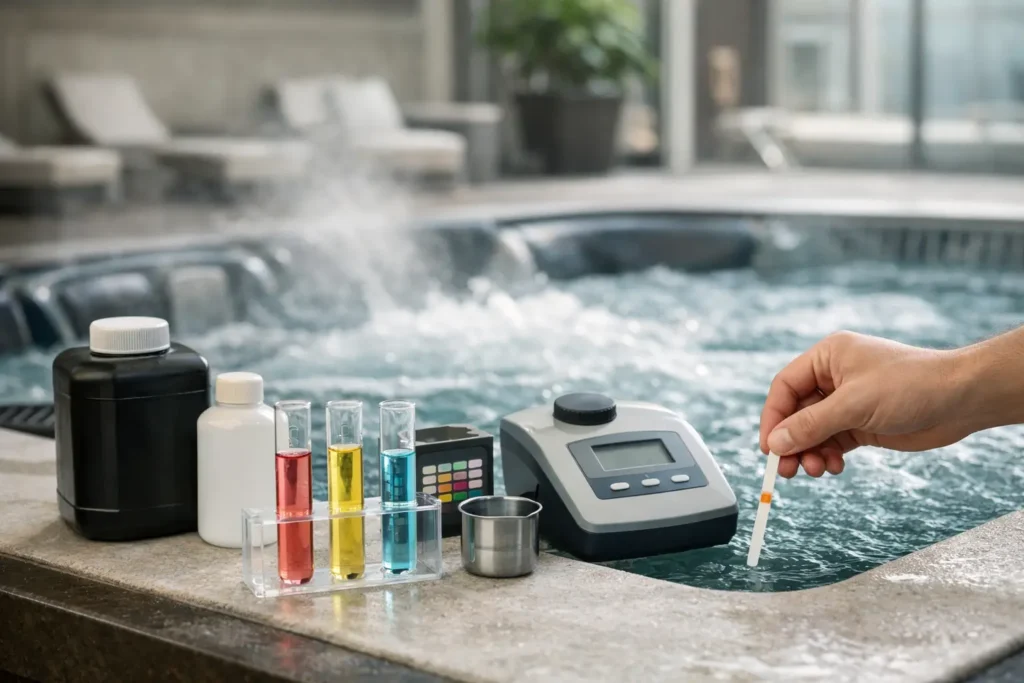
A commercial spa can move from clear and comfortable to a guest complaint, failed inspection, or equipment problem in a single busy afternoon. High water temperature, small water volume, and frequent bather use make chemistry change faster than many operators expect. This spa water chemistry guide focuses on the readings, routines, and decisions that help commercial operators keep spa water safe and within applicable health department requirements.
Why Spa Chemistry Changes Faster Than Pool Chemistry
A spa is not simply a small pool. Warm water accelerates sanitizer demand and chemical reactions, while jets and aeration can push pH upward. A few bathers can introduce sweat, body oils, cosmetics, and other contaminants that have an outsized effect on a spa’s limited water volume.
That means a passing morning test does not guarantee passing conditions later in the day. Hotels, fitness centers, apartment communities, and other high-use facilities need a testing schedule that reflects actual bather load, not just a once-per-day habit. Follow your local code, facility policy, and chemical-label instructions, which may require more frequent checks or set different operating ranges.
Spa Water Chemistry Guide: The Readings That Matter
Water balance is a system. Adjusting one number without considering the others often creates a short-term fix and a new problem tomorrow. Test with a reliable, current kit or approved photometer, collect the sample correctly, and record the result before adding chemicals.
Maintain an Effective Sanitizer Residual
Sanitizer is the first safety priority. Chlorine and bromine are the most common primary sanitizers for commercial spas, but the required type and residual depend on local regulations and the product system in use. Many commercial standards use a free chlorine range of 3 to 5 ppm or a bromine range of 4 to 6 ppm. Your local health authority may require different minimums.
For chlorine spas, distinguish free chlorine from combined chlorine. Free chlorine is available to disinfect. Combined chlorine indicates that chlorine has reacted with contaminants and is less effective. A strong chemical odor is not proof of a clean spa. It can signal chloramines and inadequate treatment.
Do not treat a low sanitizer reading as a simple dosing task if the cause is heavy use, failed circulation, an improperly functioning feeder, or poor water balance. Restore the required residual, confirm circulation and filtration, and keep the spa closed when safe operating conditions cannot be maintained. Supplemental systems such as ozone or UV can support treatment, but they do not replace the required sanitizer residual unless your jurisdiction specifically allows a different approach.
Control pH and Total Alkalinity Together
For most commercial spas, pH is commonly maintained between 7.2 and 7.8, subject to local code. Low pH can irritate bathers, corrode metal components, and damage surfaces. High pH reduces chlorine effectiveness and can contribute to cloudy water and scale.
Total alkalinity acts as a buffer against rapid pH movement. The correct target depends on the sanitizer program, source water, and facility requirements. A range around 60 to 80 ppm is often practical for many chlorine spa systems, while some programs may call for a different range. The right answer is not always to raise alkalinity to a generic pool target.
When pH keeps rising, inspect the full operating picture. Aeration from jets, high alkalinity, and certain water features can all drive pH upward. Lowering pH repeatedly without addressing the underlying cause wastes chemicals and makes records harder to interpret. Make measured adjustments, circulate thoroughly, then retest before adding more product.
Watch Calcium, Dissolved Solids, and Stabilizer
Calcium hardness protects plaster, grout, heaters, and other wetted components when kept in an appropriate range. Water that is too soft can be aggressive; water that is too hard can produce scale, especially in a hot spa. Many operators work within a calcium hardness range of roughly 150 to 250 ppm, but surface type, source water, and local requirements matter.
Total dissolved solids rise as chemicals and contaminants accumulate. Unlike pH or sanitizer, TDS generally cannot be corrected with a small chemical addition. When water becomes difficult to balance, cloudy, foamy, or slow to respond, partial draining or complete replacement may be the practical solution.
Cyanuric acid deserves special attention in outdoor chlorine spas. It protects chlorine from sunlight, but excessive stabilizer slows chlorine activity. Because stabilized products can raise cyanuric acid over time, know what each product adds to the water. Indoor spas generally do not need stabilizer, and some jurisdictions limit or prohibit it in commercial spas.
Test in the Right Order and at the Right Times
Testing is only useful when the sample represents the spa and the operator acts on the result. Take samples away from return inlets and chemical feed points, at an appropriate depth, using clean equipment. Do not test immediately after adding chemicals or topping off water unless sufficient circulation time has passed.
A practical test sequence is to check sanitizer first, then pH, then total alkalinity. If water appearance or operating history points to a larger balance issue, test calcium hardness, cyanuric acid where applicable, and other parameters required by your code. Document the time, readings, chemicals added, bather load, and any corrective action.
For a commercial spa, consider four points in the day: before opening, during peak use, after heavy use or a contamination event, and at closing. The frequency required by regulation takes priority. A low-use spa may need fewer operational interventions than a resort spa on a holiday weekend, but neither should rely on assumptions.
Make Adjustments Without Creating New Problems
The most common chemistry mistake is adding too much chemical too quickly. Spa water has low volume, so an aggressive dose can overshoot the target. Confirm the spa’s actual gallons, calculate the required amount from the product label, add chemicals in separate steps, and allow circulation before retesting.
Never mix chemicals together, and never add water into a chemical container. Add chemicals according to the manufacturer’s instructions, use proper protective equipment, and store products in a dry, ventilated area away from incompatible materials. Chemical safety is part of water safety.
Another frequent error is trying to solve cloudiness with sanitizer alone. Cloudy water can result from poor filtration, high pH, scale formation, inadequate circulation, overloaded water, or a combination of factors. Inspect filter condition, pump operation, flow, and turnover performance before assuming the answer is another chemical treatment.
Foam follows a similar pattern. It may come from body oils, soaps, cosmetics, or elevated dissolved solids. A defoamer can improve appearance temporarily, but it does not remove the source. If foam returns quickly, evaluate bather hygiene messaging, filtration, water age, and whether replacement water is needed.
Know When the Spa Should Be Closed
A commercial operator should be ready to close a spa when required sanitizer cannot be maintained, water is cloudy enough that the bottom is not clearly visible, circulation or filtration fails, contamination occurs, or a chemical incident creates an unsafe condition. Local regulations define closure and reopening requirements, so keep those rules accessible to staff.
Closing a spa is not a failure. Allowing unsafe water to remain open is the failure. Clear signage, accurate records, and a defined reopening procedure protect bathers, staff, and the facility. Before reopening, verify that chemistry is within required limits, water is clear, equipment is functioning, and any required corrective treatment has been completed.
Build Chemistry Confidence Through Operator Training
Water chemistry becomes more manageable when operators understand cause and effect instead of chasing test results. A qualified CPO course helps connect sanitizer demand, bather load, circulation, filtration, calculations, safety procedures, and local compliance responsibilities. For working professionals, live instruction can make those field decisions easier to apply on the next shift.
Keep your test kit maintained, your logs complete, and your chemical adjustments deliberate. The best time to solve a spa chemistry problem is when the numbers first begin to drift, before a guest, inspector, or damaged heater tells you it has become urgent.