
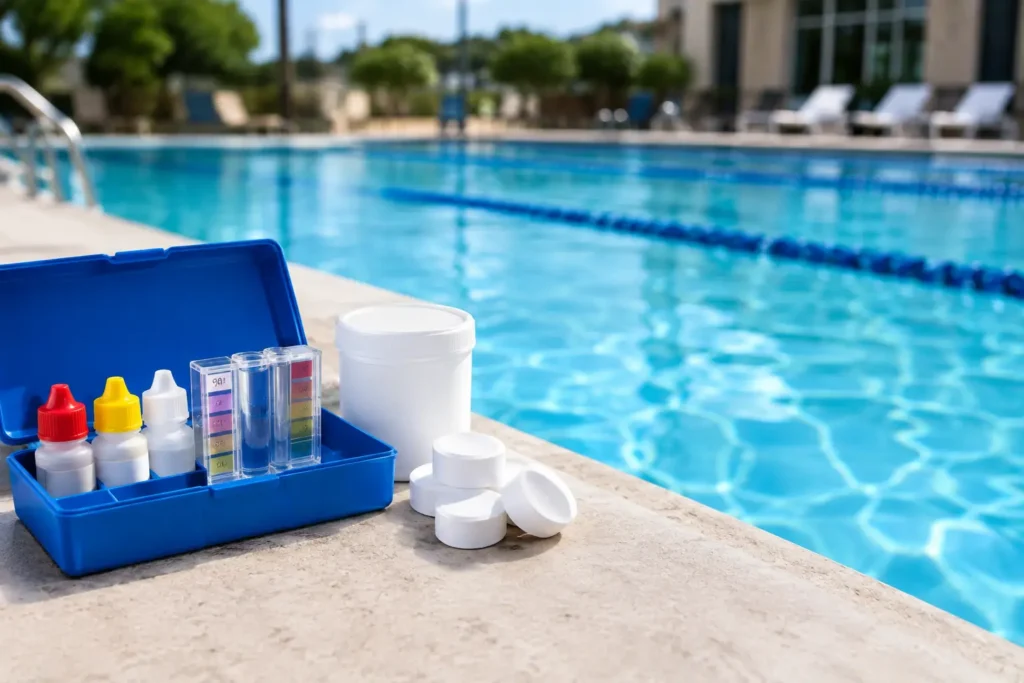
A pH reading of 8.0 may not look dramatic on a test kit, but it can quickly turn into cloudy water, scale formation, swimmer complaints, and weak sanitizer performance. Knowing how to balance commercial pool pH is a daily operating skill, not a once-a-week correction. For public and commercial facilities, consistent pH control protects equipment, helps disinfectants work as intended, and supports compliance with local health requirements.
Why Commercial Pool pH Needs Close Control
pH measures whether water is acidic or basic. The scale runs from 0 to 14, with 7.0 considered neutral. Most commercial pool codes require pH to remain within a relatively narrow range, commonly 7.2 to 7.8. Many operators aim closer to 7.4 to 7.6 because that range is comfortable for swimmers and supports effective chlorine sanitation.
A high pH can make chlorine less effective, especially when the facility relies on free chlorine as its primary sanitizer. It can also contribute to cloudy water and calcium scale on tile lines, heaters, filters, and salt cell components. When pH is too low, the water becomes more corrosive. Metal fixtures, pump components, plaster surfaces, grout, and heat exchangers may deteriorate faster. Low pH can also cause eye and skin irritation.
The correct target is not simply a single number. It depends on the pool’s sanitizer system, calcium hardness, total alkalinity, water temperature, surface type, and local code. The goal is balanced water that remains sanitary, comfortable, and non-damaging to the facility.
Test Before You Adjust
Commercial pool operators should test pH at the frequency required by their local authority having jurisdiction, with additional checks during heavy use, after severe weather, following chemical additions, or when water appearance changes. A busy hotel pool or community facility can experience meaningful chemistry shifts within a few hours.
Use a reliable DPD test kit, photometer, or properly maintained controller. Test strips can provide a quick screening result, but they are generally less precise than a professional liquid or digital testing method. If an automated controller reports an unusual reading, verify it manually before making a significant chemical correction. Probes require routine cleaning, calibration, and replacement according to the manufacturer’s guidance.
Record each result in the facility’s operating log. Document pH, sanitizer residual, total alkalinity, water temperature, chemical additions, and any corrective action. Good records help an operator identify trends instead of repeatedly treating symptoms. They also show a health inspector that the facility is being actively managed.
Check Total Alkalinity First When pH Will Not Hold
pH and total alkalinity are related, but they are not the same measurement. Total alkalinity acts as a buffer that helps prevent pH from changing too quickly. When alkalinity is too low, pH may bounce up and down even when chemical additions are small. When alkalinity is too high, pH may resist adjustment and tend to drift upward.
If pH repeatedly rises after you lower it, do not assume the acid dose was too small. Check total alkalinity, bather load, aeration, water features, and the sanitizer system. Spas, zero-entry features, fountains, slides, and spillovers introduce air into the water and commonly drive pH upward. Saltwater chlorine generators can also create a gradual upward pH trend.
Adjust total alkalinity according to the facility’s water balance plan and chemical manufacturer’s instructions. Avoid making large, rapid changes to alkalinity and pH at the same time unless you understand how each adjustment will affect the other. Retest after the water has circulated thoroughly.
How to Lower High Pool pH
Commercial operators commonly use muriatic acid or dry acid to lower pH. The right product, dose, and application method depend on the facility’s chemical program, pool volume, current pH, total alkalinity, and product concentration.
Calculate the dose using a dependable pool chemistry chart, calculator, or controller guidance. Never estimate based on what “worked last time.” A 20,000-gallon pool and a 100,000-gallon community pool require very different amounts, and acid demand changes with total alkalinity.
Before adding acid, keep circulation running and confirm that the pool is open to proper flow. Follow the chemical label and your facility procedures. Wear required personal protective equipment, which may include chemical-resistant gloves, eye protection, and appropriate protective clothing. Add the chemical slowly and carefully to the water as directed. Never add water to acid, and never mix acid with chlorine or any other pool chemical.
Allow adequate circulation time, then retest pH before making another adjustment. Overcorrecting from a pH of 8.0 to 7.0 creates a new problem and can be harder to manage than a measured correction. Small, controlled adjustments are safer for both the water and the equipment.
How to Raise Low Pool pH
Sodium carbonate, often called soda ash, is commonly used to raise pH. Depending on the water condition, sodium bicarbonate may be used when total alkalinity also needs to increase. The distinction matters: soda ash has a stronger effect on pH, while sodium bicarbonate primarily raises alkalinity.
Pre-dissolving or broadcasting methods vary by product and facility procedure. Follow the label, circulate the water, and avoid adding large quantities in one location where undissolved material could affect a surface or create localized scaling. Retest after circulation rather than assuming the full dose produced the expected result.
If a pool has low pH and low total alkalinity, correcting alkalinity first may provide a more stable result. If alkalinity is already in range, a targeted pH increase is usually the better approach. This is where accurate testing and pool math prevent unnecessary chemical use.
Do Not Treat pH as an Isolated Reading
A commercial pool can show an acceptable pH and still be poorly balanced. Review the broader water chemistry picture, including free chlorine or bromine, combined chlorine, total alkalinity, calcium hardness, cyanuric acid where applicable, temperature, and total dissolved solids. These factors affect sanitation, corrosion, scale potential, and clarity.
For example, high pH plus high calcium hardness can increase the risk of scale. Low pH combined with low alkalinity and warm water can be especially aggressive to metal and plaster. A pool that is constantly cloudy may have a filtration, circulation, bather-load, or sanitizer issue that lowering pH alone will not solve.
This is also why operators should avoid chasing a number with repeated chemical additions. Test, calculate, add a measured amount, circulate, and retest. If results do not respond as expected, investigate the cause rather than adding more product without a plan.
Common Commercial Pool pH Problems
A few patterns appear often in commercial facilities. A pool with frequent parties, swim lessons, or high weekend traffic may see pH change rapidly due to bather load, body oils, cosmetics, and sanitizer demand. Outdoor pools may shift after rain, windblown debris, refill water, or temperature swings. An indoor pool with a spa or water feature may have persistent pH rise from aeration.
Another common issue is improper chemical storage or handling. Acids and chlorine products must remain separated, clearly labeled, and stored according to code and manufacturer requirements. Chemical accidents can create immediate hazards for staff and guests. If there is a spill, fumes, or a suspected chemical reaction, follow the facility emergency plan and keep people away from the affected area.
Equipment can also be the underlying problem. A worn controller probe, poor circulation, clogged filter, failed feeder, or inaccurate flow reading can cause chemistry results that do not match the treatment being applied. Do not rely on automation without verification and routine preventive maintenance.
Build pH Control Into Daily Operations
The most dependable way to maintain commercial pool pH is to make it part of a consistent operating routine. Test on schedule, inspect the water, compare readings with the previous log entries, and correct small changes before they become major imbalances. Review trends at least weekly, particularly after high-use periods or changes in source water.
Operators also need to understand the difference between a routine adjustment and a condition that requires closure or escalation. Local code, company policy, and the severity of the imbalance determine the correct response. When water chemistry falls outside required limits, follow the approved procedure, document the action, and reopen only when readings are within the acceptable range.
CPO-level training gives operators the practical foundation to calculate doses, interpret test results, understand water balance, and make safer decisions under real facility conditions. That knowledge matters most when the pool is busy, an inspector arrives, or the readings do not behave as expected.
A clear test result, a measured chemical dose, and a complete log entry may take only a few minutes. Those few minutes can prevent a closure, protect expensive equipment, and give every swimmer a safer place to use the pool.