
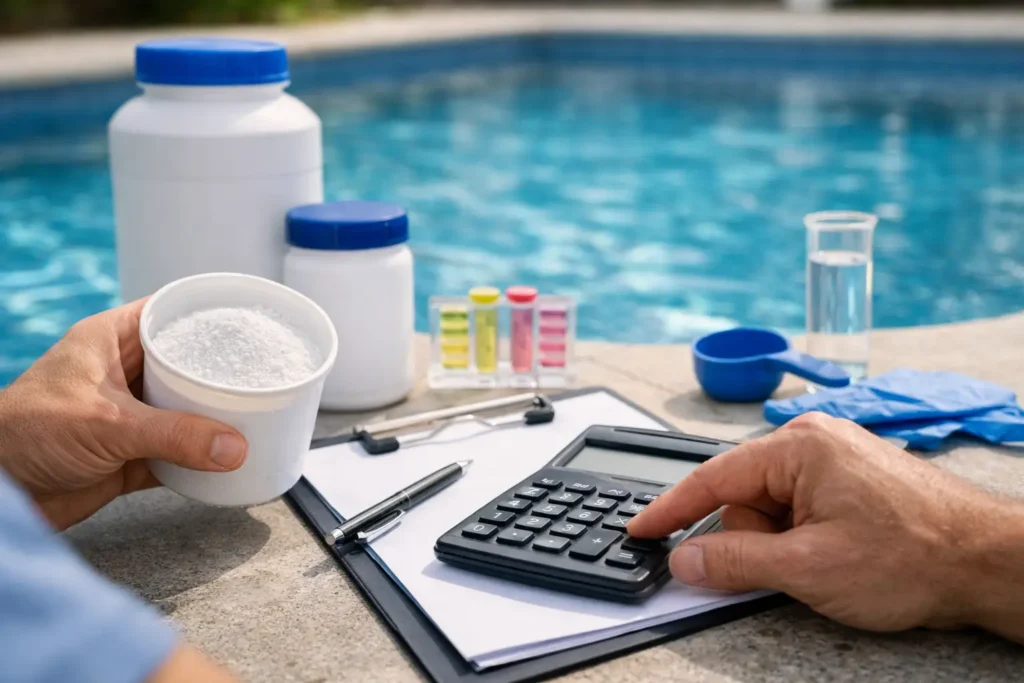
A pool can look clear and still be out of compliance. A weak sanitizer residual, rising pH, or low alkalinity may not be obvious to swimmers, but it can create a health risk and a failed inspection. Learning to calculate pool chemical dosage gives commercial pool and spa operators a repeatable way to correct water conditions without guessing, overfeeding chemicals, or damaging equipment.
The calculation is not just a math exercise. It starts with accurate testing, depends on the actual water volume, and must account for the specific strength of the product in your chemical room. The product label and local health code remain controlling sources, especially when they differ from a general dosing chart.
Start With Reliable Test Results
Chemical additions should solve a measured problem. Before calculating a dose, use a reliable test kit or properly maintained photometer and record the current reading. For a commercial pool or spa, this commonly includes free chlorine or bromine, pH, total alkalinity, calcium hardness, cyanuric acid, and, where applicable, combined chlorine.
Then identify the target. For example, if free chlorine reads 1.0 ppm and your operating target is 3.0 ppm, you need a 2.0 ppm increase. Do not automatically dose to the highest number you have seen on a chart. Required ranges vary by jurisdiction, facility type, sanitizer system, stabilizer level, and whether the body of water is a pool or spa.
A good operating log makes this easier. Record the test result, target, amount added, time of addition, and retest result. Over time, those records show normal chemical demand and make unusual changes easier to catch.
Determine the Actual Pool Volume
Every chemical calculation depends on gallons. An estimate based on a sales brochure, old service ticket, or a rounded number can produce repeated dosing errors. Confirm the volume whenever possible, especially after resurfacing, renovation, or a change in water level.
For a rectangular pool, use:
Length × width × average depth × 7.5 = gallons
For example, a 40-foot by 20-foot pool with an average depth of 5 feet contains approximately 30,000 gallons:
40 × 20 × 5 × 7.5 = 30,000 gallons
For a round pool, use:
Diameter × diameter × average depth × 5.9 = gallons
Average depth matters. Add the shallow-end and deep-end depths, then divide by two for a floor that slopes evenly. Pools with unusual shapes, multiple slopes, tanning ledges, gutters, or surge tanks require more careful measurement. In those cases, use as-built plans, a verified meter reading during filling, or an established volume calculation from the facility records.
Spas deserve the same attention. Their smaller volume means a modest measuring error can cause a much larger chemical swing.
The Basic Formula to Calculate Pool Chemical Dosage
For chemicals measured in parts per million, the core relationship is straightforward:
Pounds of pure chemical needed = 8.34 × pool volume in millions of gallons × desired ppm change
The number 8.34 represents the pounds of water in one gallon. Since most commercial pools are measured in thousands of gallons, convert gallons to millions by dividing by 1,000,000.
That formula gives the amount of the active chemical, not necessarily the amount of the product you will pour or broadcast. Commercial products are not all the same concentration. To find the product amount, divide the active chemical requirement by the product’s active percentage expressed as a decimal.
Product needed = pure chemical needed ÷ active ingredient percentage
This is why one pound of 65% cal hypo and one pound of 73% cal hypo do not produce the same chlorine increase. The same principle applies to liquid chlorine, bromine products, dry acid, alkalinity increaser, calcium chloride, and cyanuric acid. Always verify the exact product strength on the container currently in use.
Example: Raising Free Chlorine
Assume a 50,000-gallon pool needs a 2 ppm free chlorine increase and you are using a 65% available chlorine cal hypo product.
First, convert the pool volume to millions of gallons:
50,000 ÷ 1,000,000 = 0.05 million gallons
Next, calculate the available chlorine required:
8.34 × 0.05 × 2 = 0.834 pounds of available chlorine
Finally, adjust for the 65% product strength:
0.834 ÷ 0.65 = 1.28 pounds of product
In practice, measure the product accurately, add it according to the manufacturer’s instructions, keep circulation running, and retest after the appropriate mixing period. The calculated dose is a starting point based on known volume and chemistry. Bather load, sunlight, organic contamination, and circulation conditions can change the final test result.
Liquid Chemicals Need One More Conversion
Liquid products are often measured in gallons or quarts rather than pounds. After calculating the pounds of product required, divide by the product’s weight per gallon. That value varies by formulation and concentration, so use the container label or safety data information rather than assuming every gallon weighs the same.
This is a common source of errors with liquid chlorine. A stronger sodium hypochlorite solution requires less volume than a weaker one, and product strength declines with age, heat exposure, and poor storage conditions. Date containers when they arrive and rotate inventory so older product is used first.
Why pH Adjustments Require More Caution
Sanitizer calculations are relatively direct because a desired ppm increase can be calculated from volume and available strength. pH is different. The amount of acid or base needed depends heavily on total alkalinity, starting pH, water temperature, aeration, and other dissolved materials.
Use a manufacturer dosing table or an approved pool chemistry calculator for pH adjustment, then add conservatively. It is usually safer to make a partial correction, circulate, and retest than to add a large acid or soda ash dose all at once. A dramatic pH change can affect swimmer comfort, corrosion potential, sanitizer effectiveness, and water balance.
The same caution applies to total alkalinity and calcium hardness. The mathematics can estimate the required increase, but the chemical product, local water conditions, and balance index all affect the operational decision. Correcting one parameter may influence another.
Add Chemicals in a Safe Sequence
Correct calculations do not replace safe handling. Keep the circulation system operating unless the product instructions or facility procedure says otherwise. Add chemicals separately, never combine products in a bucket, feeder, or container, and never add water into chemical. Wear the required personal protective equipment and keep chemical storage areas dry, cool, ventilated, and secured.
When multiple adjustments are needed, avoid treating the water as though every correction is independent. For example, address a serious sanitizer deficiency promptly, but do not make aggressive pH, alkalinity, calcium, and stabilizer changes at the exact same time unless a qualified procedure calls for it. Add one chemical, allow proper circulation and mixing, then retest before making the next significant correction.
For severe contamination, fecal incidents, algae, equipment failures, or an inability to maintain required disinfectant residuals, follow your written response plan and applicable health department requirements. Routine dosage math is not a substitute for an incident-specific closure or disinfection procedure.
Build a Calculation Routine That Holds Up in the Field
A dependable routine protects both swimmers and the facility. Test the water, confirm the volume, identify the needed change, check the product concentration, calculate the dose, add safely, circulate, and retest. If the retest result differs significantly from the expected result, investigate rather than simply adding more chemical. The issue may be incorrect volume, degraded product, high demand, poor circulation, an inaccurate test method, or a dosing equipment problem.
Pool operators are expected to make these decisions under real conditions, often before guests arrive or while a maintenance issue is competing for attention. That is why chemical math belongs alongside safety procedures, water balance, equipment operation, and documentation in professional CPO training.
When your calculations are based on verified volume, current test results, and the actual product label, chemical treatment becomes controlled, explainable, and easier to defend during an inspection. That is the standard a commercial pool operation should aim for every day.