
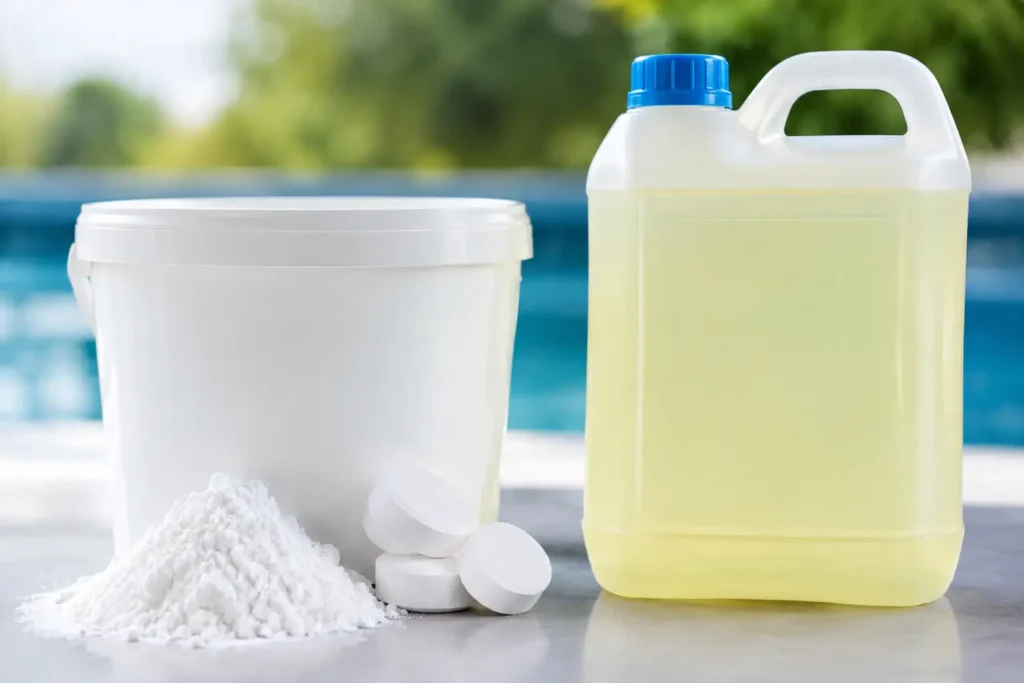
A hotel pool opens in two hours, the free chlorine is low, and the chemical room is already warm. That is when the choice between calcium hypochlorite versus liquid chlorine becomes more than a purchasing decision. For commercial pool operators, each sanitizer affects daily dosing, chemical storage, water balance, staff safety, and the facility’s ability to stay compliant.
Neither product is automatically best. The right choice depends on the pool’s calcium hardness, bather load, equipment, storage conditions, local code requirements, and the people responsible for handling chemicals. A dependable program starts with understanding what each product adds to the water – not just how quickly it raises a chlorine test result.
Calcium Hypochlorite Versus Liquid Chlorine: The Core Difference
Calcium hypochlorite, commonly called cal hypo, is a dry chlorine product. Commercial grades commonly contain roughly 65% to 73% available chlorine. It is sold as granular material, tablets, briquettes, or feeder-specific forms, depending on the application. Because it is concentrated, a relatively small amount can provide a substantial chlorine dose.
Liquid chlorine is sodium hypochlorite. It is typically delivered in refillable containers or bulk tanks for commercial facilities and commonly ranges from about 10% to 12.5% available chlorine when fresh. It is pumped or poured into a designated feed system, making it a practical option for automated treatment.
Both products create hypochlorous acid in water, the active sanitizer that controls bacteria, algae, and other contaminants. The meaningful operating difference is what remains behind. Cal hypo contributes calcium. Liquid chlorine contributes sodium and arrives as a high-pH solution. Over weeks and months, those additions can change water balance and affect how often an operator must manage total dissolved solids, calcium hardness, and pH.
When Calcium Hypochlorite Makes Sense
Cal hypo is often a strong choice for pools with low calcium hardness, particularly where source water is naturally soft. The added calcium can help bring hardness into an appropriate range and support balanced water. It is also compact. A dry product can be easier to store than the large volume of liquid needed to deliver the same amount of available chlorine.
Its concentration is useful for shock treatment and for facilities that need dependable backup sanitation on hand. A properly selected cal hypo feeder can also provide consistent routine chlorination without requiring an operator to manually dose every day.
The trade-off is calcium accumulation. Every cal hypo dose adds calcium to the water. In a facility with hard fill water, frequent evaporation, or a history of scale on heaters and tile, that accumulation can become a costly problem. High calcium hardness, elevated pH, warm water, and high alkalinity can combine to create scale conditions, especially in spas and heated pools.
Cal hypo is also a powerful oxidizer that demands disciplined storage. It must remain dry and be kept away from organic materials, acids, petroleum products, and incompatible pool chemicals. A contaminated scoop, a wet container, or improper mixing can create fire, heat, toxic gas, or violent chemical reactions. Dry chlorine is not a product to treat casually because it looks familiar.
When Liquid Chlorine Is the Better Fit
Liquid chlorine is often preferred for pools with moderate to high calcium hardness because it does not add calcium. That makes it easier to maintain a balanced saturation condition when the facility already has enough calcium in the water.
It also works well with automated chemical controllers and metering pumps. For a busy apartment community, health club, hotel, or municipal pool, automation can reduce inconsistency in routine dosing. The operator still needs to test water, verify feeder operation, inspect tubing, and document readings, but automated delivery can prevent the sharp highs and lows that come with irregular manual additions.
Liquid chlorine is generally simpler to introduce into a properly designed feed system. Unlike dry products, it does not create dust, and there is no need to open a feeder containing a strong oxidizing solid. That does not make it risk-free. Sodium hypochlorite can burn skin and eyes, damage clothing, and release hazardous gas if it contacts acid.
The primary operational drawback is degradation. Heat, sunlight, age, and contamination reduce liquid chlorine strength. A container labeled 12.5% when delivered may not remain at that strength for long in a hot chemical room. If the product weakens, the feeder may deliver less chlorine than expected, leading to low residuals and failed water-quality checks.
Liquid chlorine also requires more storage volume. A facility using significant daily chlorine demand may need large drums, a bulk tank, or frequent deliveries. Operators should confirm that containers are secured, labeled, ventilated as required, protected from excessive heat, and positioned to prevent leaks from reaching incompatible chemicals.
pH and Water Balance: Look Beyond the Daily Reading
Both cal hypo and liquid chlorine can raise pH when added. Liquid chlorine has a high initial pH, while cal hypo solutions are also alkaline. Yet the long-term pH effect is more nuanced because chlorine use and contaminant oxidation change water chemistry as well. An operator should not assume that a high-pH chlorine product will permanently drive pH upward at the same rate as the product’s label pH suggests.
What matters is the tested water. Check free chlorine, combined chlorine, pH, total alkalinity, calcium hardness, cyanuric acid when applicable, and temperature on the schedule required by your jurisdiction and facility policy. Then interpret those values together rather than correcting one number in isolation.
With cal hypo, pay close attention to calcium hardness and scaling potential. With liquid chlorine, watch sodium and total dissolved solids over time, particularly in facilities with limited splash-out, little backwashing, or minimal water replacement. Neither issue is solved by simply adding more acid. Acid may lower pH, but it does not remove calcium, sodium, or dissolved solids from the pool.
A well-managed dilution plan, appropriate filtration practices, and accurate records are often the difference between routine chemical adjustment and a preventable water-quality problem.
Dosing and Handling Rules That Protect Staff
The chlorine source matters, but handling procedures matter just as much. Use the product label, Safety Data Sheet, feeder manufacturer instructions, and local health requirements as the operating standard. Never rely on informal shortcuts from a previous employee or another property.
For cal hypo, use only clean, dry, dedicated equipment. Do not mix it with other dry chemicals, do not place it in a feeder not designed for cal hypo, and do not store it where leaks or spills from acid can reach it. If the label directs pre-dissolving, use the specified method and add chemicals to water as instructed – never reverse the process.
For liquid chlorine, use compatible pumps, tubing, fittings, and containment. Never mix liquid chlorine with acid in a bucket, tank, line, or feeder. Chemical feed lines should be arranged to prevent backflow and cross-contamination. Staff should know what to do for a spill, leak, exposure, or unexpected chemical odor before an incident occurs.
Personal protective equipment should match the task and the product label. At a minimum, that commonly includes chemical-resistant gloves and splash protection. Facilities should also maintain accessible eyewash capability and train staff to report damaged containers, leaking lines, and unusual product appearance immediately.
Cost Is More Than the Price Per Container
A low purchase price can be misleading. Compare products by available chlorine delivered, not by container cost alone. Then account for freight, storage space, equipment, labor, shelf life, water-balance corrections, and the cost of draining and refilling water when dissolved solids or hardness become excessive.
Cal hypo may cost less to store and transport because it is concentrated, but its calcium contribution may create additional balance work. Liquid chlorine can support convenient automated dosing, but degraded inventory and delivery logistics can increase its real cost. The best program is the one your team can dose accurately, store safely, monitor consistently, and document reliably.
Make the Choice Part of a Complete Operating Plan
A commercial pool should not select a sanitizer based on habit alone. Review source-water chemistry, test records, seasonal bather load, equipment compatibility, chemical-room conditions, and the requirements of the local authority having jurisdiction. If scaling has been persistent, cal hypo may be the wrong routine sanitizer. If heat and inventory age make chlorine strength unpredictable, liquid chlorine may require better delivery scheduling or storage improvements.
This is the practical judgment expected of a trained operator. A live CPO course helps connect chemical calculations and safety rules to the real decisions made in equipment rooms, pump areas, and daily logbooks.
Choose the product that supports stable water chemistry and safe staff procedures, then verify that choice with consistent testing. A chlorine program works best when it is managed as part of the entire pool system – not as a single chemical added to solve today’s reading.