
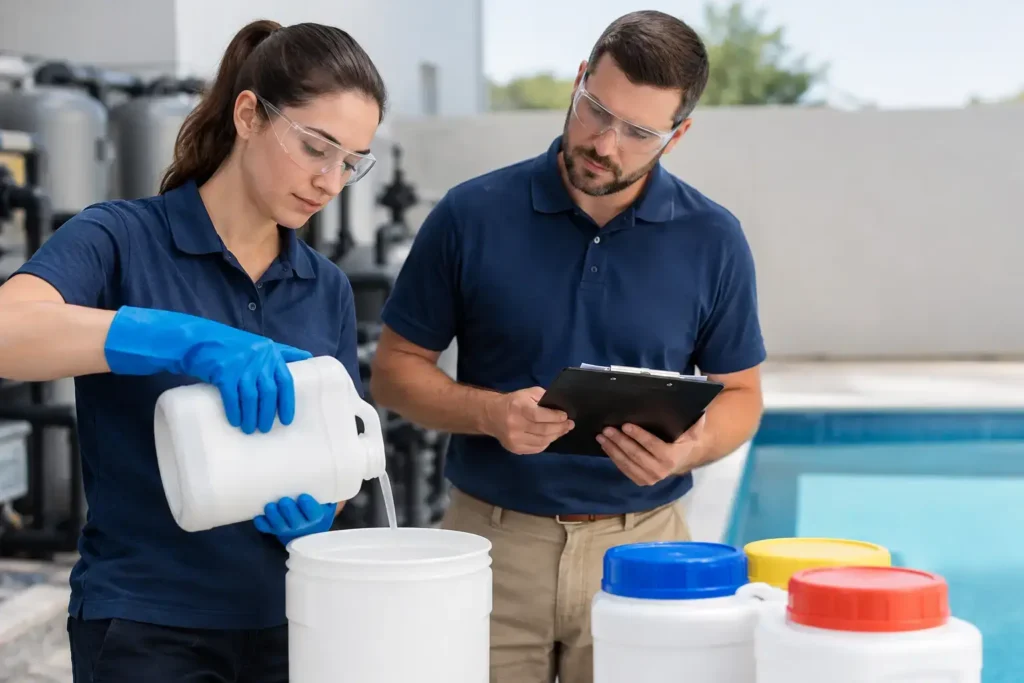
A chemical room can look orderly right up until a rushed employee reaches for the wrong container, skips protective equipment, or adds water to a chemical instead of the other way around. To train pool chemical handlers effectively, facilities need more than a quick walkthrough of storage shelves. They need role-specific instruction, supervised practice, and clear limits on who may perform each task.
For hotels, HOAs, fitness centers, apartment communities, and public facilities, chemical-handling training protects swimmers, staff members, and the operation itself. It also supports the documentation and consistent procedures health departments expect from commercial pool and spa operators.
Start with the actual work your team performs
Not every employee assigned to a pool needs the same chemical-handling authority. A maintenance technician who receives deliveries, mixes solutions, tests water, adjusts feeders, and responds to incidents needs deeper training than a front-desk employee who only needs to recognize an unsafe condition and report it.
Begin by defining the tasks each person is authorized to do. This prevents a common failure point: giving staff broad access to a chemical room after only general safety training. Written task assignments should cover receiving and moving chemicals, storage checks, water testing, manual dosing, feeder operation, recordkeeping, and emergency response.
Training should reflect the equipment at the property. A facility using liquid chlorine and an acid feed system has different risks from one using calcium hypochlorite, bromine, or salt chlorine generation. Generic instruction is useful as a foundation, but operators need to understand the products, feeders, ventilation, eyewash stations, and shutoff controls they will encounter on site.
Teach chemical hazards before teaching chemical adjustments
New handlers often focus first on getting a test result back into range. That is understandable, but safe operation starts with knowing what can go wrong before any container is opened.
Each handler should be able to locate and use the Safety Data Sheet for every product stored at the facility. They should understand the product label, required personal protective equipment, first-aid measures, incompatibilities, storage requirements, and spill-response instructions. The label and Safety Data Sheet govern the work. Informal habits passed down from a previous employee do not.
Make incompatibility training specific. Chlorine products must be kept away from acids, petroleum products, ammonia-containing materials, organic debris, and incompatible chemicals. Even different chlorine formulations may have separate storage requirements. Staff should never combine products, transfer chemicals into unmarked containers, or assume two substances are compatible because both are used for pools.
The same principle applies to dilution. Teach the approved procedure for the product in use, including whether a chemical is added to water, the required container, and the reason for the sequence. A rushed shortcut can create heat, splashing, toxic gas, fire, or a violent reaction.
Build hands-on practice into pool chemical handler training
A video or policy acknowledgment cannot show whether someone can safely lift a container, read a feeder setting, or respond appropriately when a pump loses prime. After initial instruction, provide supervised practice on the tasks the employee will be assigned.
Have trainees demonstrate how they inspect the chemical room before entering work: checking for unusual odors, leaks, damaged containers, poor ventilation, blocked access, and missing protective equipment. They should know that a strong chlorine-like odor may indicate a problem, not a clean room.
Then observe them performing routine work. This may include retrieving a Safety Data Sheet, wearing the correct eye and skin protection, completing a water-test log, checking chemical-feed equipment, and recording the action taken. The goal is not speed. It is a repeatable procedure that remains safe during a busy shift.
A useful supervisor question is: “What would make you stop work right now?” A properly trained handler should answer with conditions such as an unknown leak, incompatible products stored together, a damaged container, failed ventilation, missing safety equipment, or a chemical odor that suggests a release. They should not feel pressure to solve every problem alone.
Make emergency actions simple and visible
During a chemical incident, people rely on the steps they remember clearly. Emergency procedures should therefore be short, posted near the chemical area, and practiced before an incident occurs.
For a spill, release, or suspected gas exposure, employees should know when to stop work, isolate the area, keep people away, alert management, and contact emergency responders. They need to know the facility’s evacuation process and where to find emergency contacts. Only staff trained and equipped for the specific response should attempt cleanup.
Eye exposure and skin exposure require immediate action, which is why accessible eyewash and drench equipment matters. Trainees should know where the equipment is, how to activate it, and the importance of following product-specific first-aid instructions. Emergency equipment that is blocked by boxes or located behind a locked door is not a workable control.
Avoid teaching employees to improvise chemical neutralization or cleanup. The correct response depends on the chemical, the quantity, the location, and the instructions provided by the manufacturer and responding authorities. A small, contained event may be handled under an approved site procedure. A larger release, strong fumes, or an unknown reaction calls for evacuation and professional response.
Connect safe handling to water chemistry decisions
Chemical safety and water balance are connected. Operators make better dosing decisions when they understand why a reading matters, how much chemical is actually needed, and what effect the adjustment will have on pH, alkalinity, sanitizer level, calcium hardness, and overall bather comfort.
Train staff to test before adding chemicals, use properly maintained test equipment, and record both readings and corrections. Guessing creates safety risks as well as water-quality problems. It can lead to overfeeding, corrosion, scaling, irritated swimmers, or a closure that could have been avoided.
This is where formal operator education adds value. A Certified Pool/Spa Operator course gives personnel the foundation to understand circulation, filtration, disinfection, water balance, and operational records rather than simply reacting to one number at a time. CPO.Training provides live, instructor-led instruction that helps operators connect those concepts to field decisions without travel.
Certification does not replace a facility’s product-specific training. Instead, it gives the responsible operator a stronger framework for supervising chemical use, maintaining compliant procedures, and recognizing when conditions require outside support.
Document training and verify competency
A sign-in sheet proves attendance. It does not prove competence. Maintain records showing the subjects covered, the products and equipment discussed, the instructor, the date, and the employee’s observed demonstration of assigned tasks.
Retraining should occur when the facility changes products, installs new feed equipment, updates emergency procedures, or identifies an unsafe practice. It is also appropriate after an incident, near miss, extended absence, or seasonal reopening. For seasonal facilities, a pre-opening refresher is particularly valuable because staff may remember the routine but overlook changes made during the off-season.
Supervisors should also conduct periodic chemical-room inspections. Look for expired or damaged products, clear labels, separation of incompatible materials, functioning ventilation, usable personal protective equipment, accessible emergency supplies, and current logs. These inspections turn training into an operating standard instead of a one-time event.
Questions to use during a safety check
Before authorizing a new employee to handle pool chemicals independently, ask practical questions that reveal judgment, not memorization. Can the employee identify incompatible products? Do they know where the Safety Data Sheets are kept? Can they explain what to do if they smell strong fumes or see a leak? Do they know who has authority to adjust feeders or order chemicals?
If the answer is uncertain, provide more coaching and direct supervision. The cost of another training session is minor compared with an employee injury, facility evacuation, damaged equipment, or preventable health-department violation.
Well-trained chemical handlers do not need to be chemists. They do need to understand their limits, follow the label every time, and recognize when to stop and ask for help. That discipline is what keeps a routine pool maintenance task from becoming an emergency.