
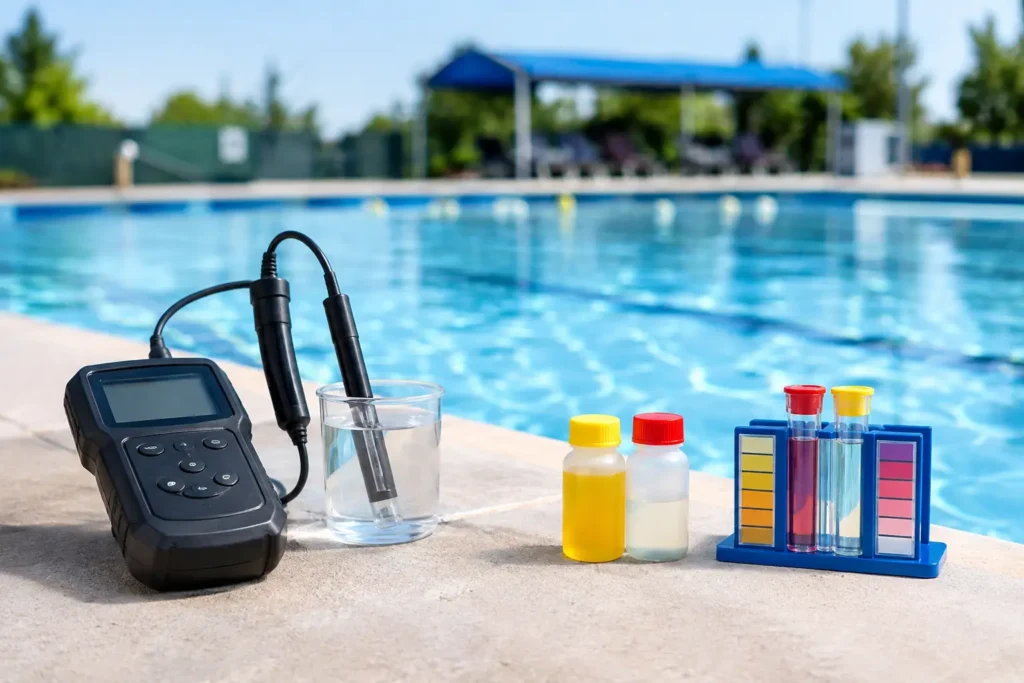
A controller shows 750 mV, but the chlorine test reads low. Or the chlorine residual is where it should be, while the ORP reading is lower than expected. For a commercial pool operator, ORP versus chlorine is not a choice between two competing measurements. They answer different questions about the same sanitation program, and understanding the difference helps prevent unsafe water, unnecessary chemical adjustments, and compliance problems.
ORP Versus Chlorine: Two Different Measurements
Chlorine testing measures the concentration of chlorine residual in the water, typically in parts per million (ppm). In daily operations, the most useful result is free available chlorine (FAC). This is the portion available to disinfect water, oxidize contaminants, and provide a continuing sanitizer residual for bathers.
Oxidation-reduction potential, or ORP, measures the water’s oxidizing strength in millivolts (mV). In practical terms, it reflects how readily the water can oxidize contaminants and inactivate microorganisms. ORP is commonly monitored by automated chemical controllers that feed chlorine based on a selected mV setpoint.
The distinction matters. A chlorine test tells an operator how much measurable sanitizer residual is present. An ORP reading indicates the overall sanitizing environment at that moment. Neither number tells the whole story by itself.
A pool can have an acceptable chlorine residual but a reduced ORP because pH is high, cyanuric acid is elevated, or the water contains a heavy contaminant load. Conversely, a controller may maintain a strong ORP reading while a manual chlorine test reveals a problem with testing technique, circulation, chemical feed, or the probe itself. Operators need both the automated data and reliable manual testing.
Why pH Changes the Relationship
The most common reason ORP and chlorine readings appear to disagree is pH. When chlorine is added to water, it forms hypochlorous acid and hypochlorite ion. Hypochlorous acid is the more active disinfecting form. As pH rises, a greater share of free chlorine shifts toward the less active hypochlorite ion form.
That means two pools may each test at 2.0 ppm free chlorine, yet their disinfecting performance can differ substantially if one pool has a much higher pH. ORP generally responds to that difference. A rising pH can lower ORP even when the measured chlorine residual has not changed much.
This is why an operator should not respond to a low ORP reading by automatically adding more chlorine. First, check pH. If pH is above the facility’s required operating range, correcting pH may improve chlorine effectiveness and bring ORP back toward the controller setpoint without creating an excessive chlorine residual.
Temperature also affects ORP. Warm water, especially in spas, increases chemical demand and changes the way readings behave. A spa serving a busy fitness center or hotel may need closer attention than a lightly used outdoor pool, even if both have automated controls.
Cyanuric Acid Can Lower ORP Readings
Cyanuric acid (CYA), often called stabilizer or conditioner, protects chlorine from rapid sunlight degradation in outdoor pools. It has a legitimate role where allowed by local code. However, it also changes the relationship between a free-chlorine test result and chlorine’s immediate activity in the water.
As CYA increases, a standard DPD test may still show a measurable free-chlorine residual, but ORP can read lower. That does not mean the ORP probe is necessarily defective. It may indicate that stabilizer is reducing the amount of immediately active chlorine available at any given time.
This is particularly relevant for outdoor pools that receive repeated additions of stabilized chlorine products. Without routine CYA testing and water replacement as needed, stabilizer can accumulate. Operators may then chase ORP by feeding more chlorine, only to create higher total chlorine cost, stronger odors, more difficult water balance, and a residual that exceeds code or facility policy.
Always follow the health department requirements that apply to your facility. Some jurisdictions limit CYA tightly, and many prohibit its use in spas. A public or commercial facility should never rely on a generic target from another property or another state when local code establishes the operating standard.
What an ORP Controller Does Well
An ORP controller is valuable because it can respond to changing conditions faster than periodic hand testing alone. As bathers enter the water, bring in perspiration, cosmetics, and other organic material, the oxidizer demand changes. A properly maintained controller can signal chemical feed equipment to maintain a more consistent sanitizing environment.
For high-use commercial facilities, that responsiveness is a major operational advantage. It helps reduce the long periods of underfeeding or overfeeding that can occur when chemicals are adjusted only a few times each day.
But ORP automation does not replace the operator. An ORP probe can become coated with scale, oils, or biofilm. It can drift, age, lose proper electrical connection, or be installed where water flow is inadequate. A controller can only make decisions based on the information its sensors provide.
A practical operating routine includes inspecting the controller, verifying adequate sample flow, cleaning and maintaining probes according to the equipment manufacturer’s instructions, and comparing automated readings with accurate manual test results. If the controller reading and manual test repeatedly conflict, investigate before changing feed settings.
Why Manual Chlorine Testing Still Matters
Health departments typically require manual water testing and documented records, regardless of whether the facility uses automation. The manual test is the operator’s direct verification of free chlorine, combined chlorine, pH, and other required water-quality conditions.
A quality DPD test kit or approved photometer provides information an ORP controller does not. Combined chlorine, for example, is formed as chlorine reacts with contaminants. Elevated combined chlorine can point to insufficient oxidation, heavy bather contamination, or the need for a corrective treatment permitted by code and the facility’s procedures. ORP alone cannot identify combined chlorine.
Manual testing also helps reveal when an apparent chemistry issue is actually an equipment issue. If the controller calls for chlorine but the manual FAC result does not increase, check the feeder, chemical supply, pump operation, injection point, circulation, and safety interlocks. Do not assume the problem is simply a low setpoint.
For facilities with spas, frequent testing is especially critical. Small water volume, high temperature, and concentrated bather use can cause sanitizer and pH to shift quickly. A chemical controller is helpful, but it is not a substitute for required test intervals and operator observation.
A Practical Response When Readings Do Not Match
When ORP and chlorine results seem inconsistent, slow down and verify the basics. Retest with fresh reagents and a clean sample cell. Confirm that the sample was taken from a representative location and that the test method was performed correctly. Then compare free chlorine, combined chlorine, pH, temperature, and, where applicable, cyanuric acid.
Next, inspect the automated system. Verify sample flow through the sensing cell, probe cleanliness, calibration or standardization procedures required by the manufacturer, chemical inventory, feed pump operation, and circulation. Look for recent changes in bather load, weather, makeup water, chemical products, or maintenance activity.
Avoid making large chemical corrections based on one unusual reading. A rapid increase in chlorine can create a new compliance issue, damage surfaces or equipment, and force a closure if it exceeds permitted levels. A measured response based on confirmed data is safer for swimmers and easier to document.
Setpoints Must Follow the Facility’s Requirements
There is no universal ORP setpoint that guarantees compliance in every pool. Equipment manufacturers may provide recommended ranges, but a setpoint must be evaluated in the context of the pool’s disinfectant, pH range, CYA use, temperature, circulation, bather load, and local regulatory requirements.
The same principle applies to chlorine residuals. Required minimum and maximum levels vary by disinfectant type, whether the vessel is a pool or spa, and the jurisdiction overseeing the facility. Operators should know the applicable code, maintain clear logs, and follow the written procedures for their property.
CPO training helps operators connect these readings to real decisions: when to adjust pH, when to inspect equipment, when to test again, and when conditions require closing the pool or spa. The goal is not to chase a single number. It is to maintain water that is safe, properly disinfected, and within the standards that govern the facility.
The best operating habit is simple: use ORP as a continuous indicator, use manual chlorine testing as verification, and let complete water-balance data guide every adjustment. That approach protects bathers, supports compliance, and gives operators a defensible record of sound daily decisions.