
A failed pool inspection rarely comes down to one dramatic mistake. More often, it is a combination of small operational gaps: an expired test kit, incomplete chemical logs, a gate that does not self-close, or staff who cannot explain how they respond to a low disinfectant reading. California pool compliance is built on daily discipline, not last-minute inspection prep.
For property managers, maintenance teams, and service professionals, the goal is straightforward: keep the pool safe for bathers, maintain required records, and make sure the person responsible for operation has the knowledge to act when conditions change. The details can vary by facility and local health department, but the operating standard should never be casual.
What California Pool Compliance Covers
Public and commercial pools in California are regulated through state health and safety requirements, California Code of Regulations provisions, building standards, and local environmental health department rules. Apartments, hotels, fitness centers, HOA facilities, schools, recreation centers, and similar properties may all fall under public pool oversight even when access is limited to residents, members, or guests.
Compliance is not limited to clear water. Inspectors generally look at the entire operating system: circulation, filtration, disinfection, chemical balance, safety equipment, barriers, signage, records, and operator competency. A pool can look clean and still create a serious compliance issue if the disinfectant residual is inadequate, the main drain cover is not compliant, or the facility cannot show routine testing.
Local requirements matter. County and city health departments may apply additional rules, require specific forms, or interpret inspection priorities differently. Treat state requirements as the baseline, then confirm the expectations of the authority having jurisdiction for your facility.
Public pools and residential pools are not the same
California pool safety laws also address residential swimming pools, particularly barriers and drowning prevention features for private homes. Those requirements are important, but they are not a substitute for the sanitation and operational rules that apply to public or commercial facilities.
A hotel pool, apartment pool, or community spa must be managed as an operating water system. That means documented testing, trained oversight, safe chemical handling, properly functioning equipment, and prompt correction when readings fall outside the acceptable range.
The Four Areas Inspectors Notice First
Most inspection failures can be traced back to a handful of recurring categories. These are also the areas where a well-trained operator can prevent problems before a guest, resident, or inspector finds them.
1. Water quality and disinfection
Disinfectant is the first line of defense against recreational water illness. Operators need to test free chlorine or bromine, pH, and other required parameters at the frequency required for the facility. The right target depends on the pool type, treatment system, local rules, and whether cyanuric acid is used.
A number written in a log is not enough. Staff must know what that number means and what to do next. Low disinfectant, high pH, cloudy water, excessive combined chlorine, or a circulation failure may require immediate corrective action, restricted use, or closure. Continuing to allow bather access while waiting for chemistry to correct can turn an operational issue into a health department violation.
Spas deserve extra attention. Their elevated temperature, smaller water volume, and heavy bather load allow water conditions to change quickly. A spa that was within range in the morning may need adjustment well before the end of the day.
2. Records that show real oversight
Pool logs are evidence that the facility is being actively managed. They should be legible, current, and completed by someone who understands the readings being recorded. Depending on the jurisdiction, documentation may include chemical test results, water temperature, equipment checks, corrective actions, incidents, and filter or chemical service records.
The strongest logs do more than list numbers. They show a clear sequence: the operator identified an issue, took the appropriate action, retested the water, and documented the outcome. For example, if free chlorine is low, the log should not simply show a later acceptable result. It should reflect the response taken and the confirmation test.
Avoid filling in logs from memory at the end of a shift. That practice creates inaccurate records and makes it harder to identify trends, such as a feeder that is not keeping pace with swimmer demand or a pH controller that is drifting.
3. Barriers, gates, and safety equipment
Drowning prevention is an everyday operational responsibility. Pool enclosure gates must close and latch as intended, fencing must remain secure, and access points cannot be defeated by makeshift repairs or propped-open doors. Operators should check these items during routine walkthroughs, especially after landscaping work, deliveries, storms, or contractor activity.
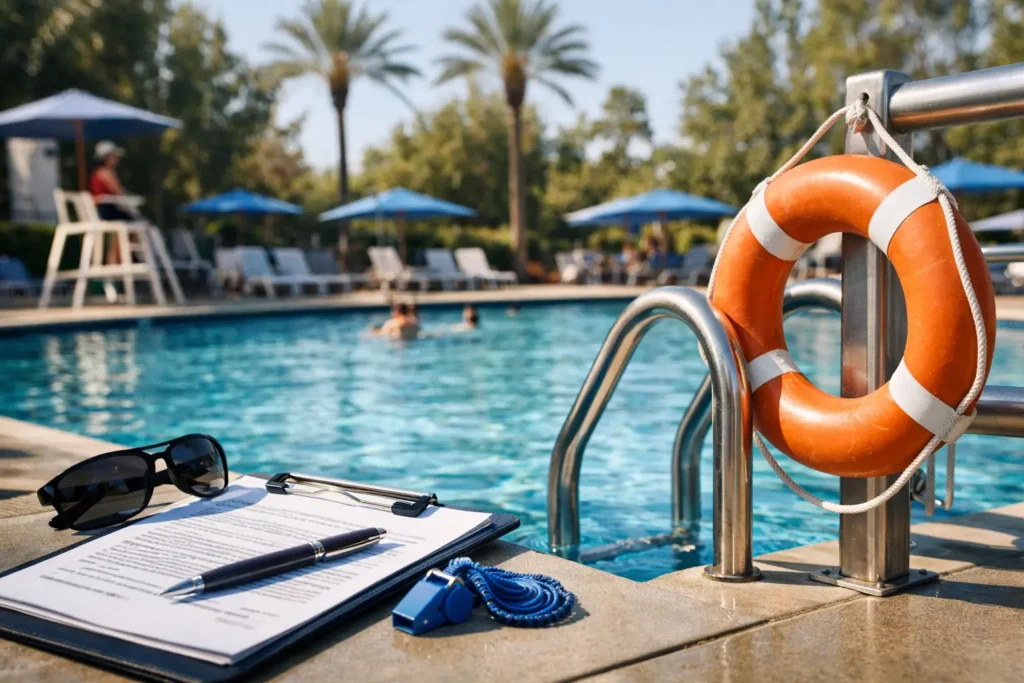
Required safety equipment must be present, accessible, and usable. This may include a reaching pole, life ring, emergency telephone or other approved communication method, depth markers, safety signage, and clearly posted rules. Exact requirements vary, so match your inventory and placement to the approved plans and local department standards.
Drain cover compliance also belongs in this category. Missing, damaged, loose, or expired suction outlet covers should never be treated as a cosmetic maintenance item. They can present an entrapment hazard and may require closing the affected pool or spa until corrected.
4. Equipment rooms and chemical practices
An organized equipment room supports safer decisions. Chemicals should be labeled, stored according to their compatibility, protected from unauthorized access, and kept away from conditions that could create a spill, fire, or toxic gas release. Never assume that a clean-looking storage area is safe if incompatible products are stored too closely together.
Operators should understand circulation flow, filter pressure, pump operation, feeder settings, backwashing or cleaning procedures, and how to recognize abnormal equipment behavior. A pump that loses prime, a sudden pressure change, or a feeder that is empty can affect water quality faster than many teams expect.
Chemical additions should be measured and handled according to product instructions and facility procedures. Mixing chemicals, adding water to certain products improperly, or working without basic protective equipment can create immediate hazards. When a repair or adjustment is outside the operator’s authority or expertise, escalate it rather than improvising.
Certification Is an Operational Requirement, Not Just a Credential
California public pool operations require trained, qualified oversight. A nationally recognized pool operator certification is commonly the practical standard used to demonstrate that a responsible person understands water chemistry, equipment, sanitation, safety, and recordkeeping. Certification also helps property owners show that pool care is being managed by someone prepared to make informed decisions.
The value is most visible when conditions are not routine. Anyone can record a normal chlorine reading. A trained operator knows how to respond when chlorine demand rises after a busy weekend, when pH will not stabilize, when a pump failure affects turnover, or when a fecal incident requires an appropriate closure and disinfection response.
For busy professionals, live online training can remove the travel barrier without reducing the need for practical instruction. CPO.Training provides a live, instructor-led two-day format designed to help operators build field-ready knowledge while earning a recognized credential.
A Better Way to Prepare for Inspection
Do not wait until an inspection notice arrives. Build a weekly compliance review into the operating routine. Walk the enclosure, inspect gates and signage, review chemical inventory, look over equipment, confirm test-kit accuracy, and check that logs are complete. This takes less time than recovering from a failed inspection or an avoidable closure.
It also helps to assign clear responsibility. In many facilities, several people may touch the pool area, but no one owns the final check. Identify the certified operator or responsible lead, define who performs daily testing, and establish who has authority to close the pool when safety or water quality is compromised.
What should staff do when a reading is out of range?
Staff should follow the facility’s written operating procedure, take corrective action within their training and authority, and keep bathers out of the water when conditions create a safety or sanitation concern. Retest after correction and document both the issue and response. If the problem cannot be resolved promptly, contact the qualified operator, service provider, or local health department as appropriate.
How often should pool rules be reviewed?
Review procedures whenever staffing changes, equipment is replaced, a health department issue is identified, or a significant incident occurs. A scheduled seasonal review is also useful, particularly before peak use periods when bather loads and chemical demand increase.
The best time to correct a compliance problem is during a normal morning walkthrough, when the pool can be taken out of service calmly and reopened safely. That is what trained operation looks like: fewer surprises, clearer decisions, and a facility ready for the people who depend on it.