
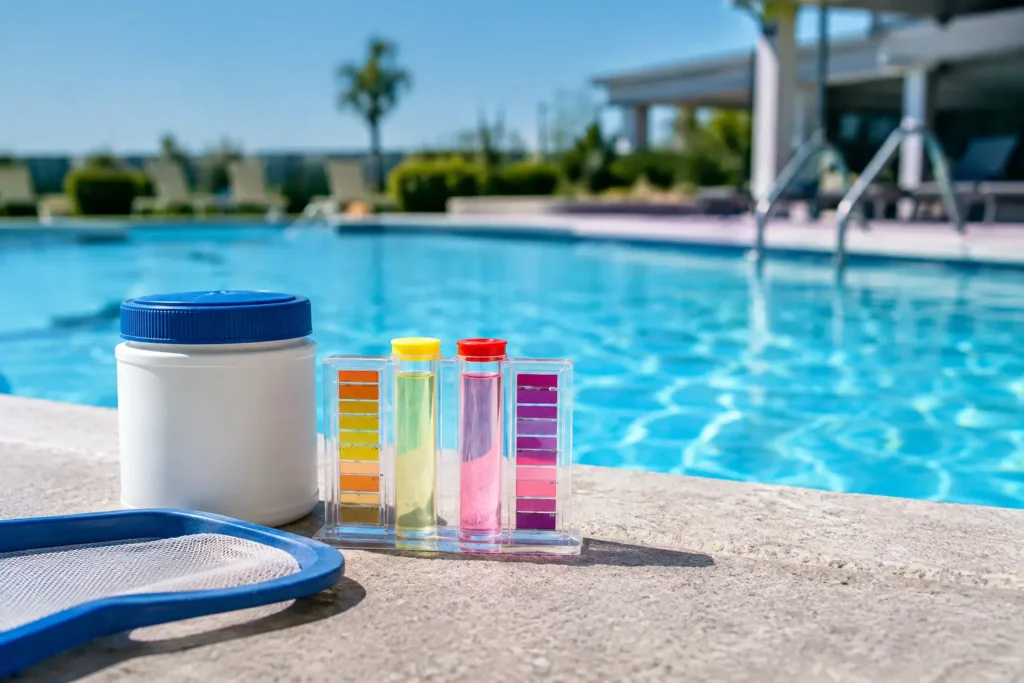
A chlorine reading can look acceptable on a test strip while the pool is still difficult to sanitize. That is often the moment operators need to know how to balance cyanuric acid. Cyanuric acid, commonly called CYA or conditioner, protects chlorine from sunlight, but too much protection can slow chlorine’s sanitizing action. For public and commercial facilities, that is not a minor chemistry issue. It can affect bather safety, inspection results, closure decisions, and the time your team spends chasing unstable water.
What cyanuric acid does – and why balance matters
Cyanuric acid forms a temporary bond with free chlorine. Outdoors, this is useful because ultraviolet sunlight destroys unprotected chlorine quickly. A properly conditioned outdoor pool holds chlorine longer through the day, reducing chemical demand and making routine operation more predictable.
The trade-off is chlorine activity. As CYA rises, a larger share of chlorine is held in reserve rather than immediately available to kill pathogens and control algae. Standard free-chlorine readings do not tell the whole story when CYA is high. An operator may keep adding chlorine, see a test result within a familiar range, and still find that the pool struggles with cloudy water, algae pressure, or combined chlorine.
Indoor pools generally receive little or no benefit from CYA because they are not exposed to direct sunlight. Many jurisdictions prohibit it in indoor pools and spas, and some public-pool codes set specific limits for outdoor facilities as well. Always follow the local health department rule first. Manufacturer guidance and general industry ranges cannot override the code that applies to your property.
Test before you try to correct it
Do not balance CYA by guesswork. Test it with a dependable method and record the result alongside free chlorine, combined chlorine, pH, total alkalinity, calcium hardness, and water temperature. A high-quality drop test or photometer is generally more useful for operational decisions than a basic strip, particularly when the reading is near a code limit.
Take the sample from the pool, away from return inlets and skimmers. For larger pools, collect a representative sample at elbow depth. If you use a service company, compare its readings with your in-house log periodically. A disagreement does not automatically mean either party is wrong, but it is a reason to verify the test method, reagents, expiration dates, and sampling process.
For an outdoor commercial pool, many operators aim for a modest CYA level, often around 30 to 50 ppm when allowed by local code. The correct target depends on the facility, sanitizer program, sunlight exposure, and health department requirements. Spas and indoor pools are different cases. Because spas have high temperatures, high bather loads, and rapid chemical changes, they need close attention to the applicable code and product instructions.
Where excess CYA comes from
CYA does not normally disappear through evaporation or get consumed as chlorine works. It accumulates when stabilized chlorine products are used repeatedly. Trichlor tablets and dichlor granules add both chlorine and cyanuric acid. They can be useful products in the right application, but they are not chemistry-neutral.
Trichlor also has a low pH and adds acid demand. Dichlor has a more moderate pH effect, but it can increase CYA quickly during startup, heavy-use periods, or routine shocking. If a facility uses these products without tracking CYA, a manageable number can become an operational problem over a season.
This is why product labels matter. A pail labeled as chlorine may also be adding stabilizer, calcium, salt, or other components. The operator’s job is to understand what each treatment changes, not just what it is intended to fix.
How to balance cyanuric acid when it is too high
There is no dependable chemical additive that removes excess CYA from a commercial pool under normal operating conditions. The practical correction is dilution: remove a portion of pool water and replace it with fresh water that has little or no CYA. The amount required depends on the current reading, your target, and the CYA level of the fill water.
As a rough example, if a pool tests at 100 ppm and the target is 50 ppm, replacing about half the water may bring the level close to target, assuming the replacement water contains no CYA. Real-world results can vary because of mixing, splash-out, backwashing, and fill-water conditions. Retest after circulation has thoroughly mixed the new water before making another large adjustment.
Do not drain a commercial pool without considering structural and safety risks. High groundwater, hydrostatic pressure, local restrictions, and the pool’s construction can make a full drain hazardous. Coordinate with qualified pool professionals when significant water removal is needed. Follow local discharge rules as well, especially when water contains chlorine or is sent to a sanitary or storm system.
While lowering CYA, stop or reduce the stabilized products causing the buildup. Use the sanitizer approach approved for your facility and your local code. For many commercial pools, that may mean liquid chlorine, sodium hypochlorite feed, calcium hypochlorite, or another approved system. Each choice has its own effect on pH, calcium hardness, salt content, storage, and handling requirements.
Keep chlorine effective during the correction
High CYA can require a higher free-chlorine concentration to maintain effective sanitation. The exact operational target should be based on your governing code, facility policy, and sanitizer system. Do not assume that a single generic chlorine range fits every stabilized pool.
If the pool cannot maintain safe, code-required disinfectant residuals, has visible algae, or produces water-quality conditions that create a health concern, take the action required by your jurisdiction. That may include closing the pool until water chemistry is corrected. A temporary closure is disruptive, but operating with ineffective sanitation creates a much larger risk.
What to do when CYA is too low
For an outdoor pool that relies on chlorine and receives strong sun, very low CYA can mean rapid chlorine loss. Before adding conditioner, verify that the loss is not caused by heavy bather load, organic contamination, algae, poor circulation, inaccurate testing, or a feeder issue.
When CYA genuinely needs to be raised and code allows it, add cyanuric acid carefully according to the product label. Granular conditioner dissolves slowly and can damage surfaces or clog equipment if applied incorrectly. Many operators place it in a sock or use another manufacturer-approved method that keeps undissolved material out of the skimmer and away from finishes. Do not backwash or clean the filter immediately after adding it if doing so could remove undissolved product.
Avoid adding a full season’s worth of conditioner at once. CYA can take time to dissolve and register accurately on a test. Add conservatively, circulate as directed, and retest before adding more. Overshooting creates the same dilution problem you were trying to prevent.
Build CYA control into the operating routine
The easiest way to manage cyanuric acid is to prevent gradual buildup from becoming an emergency. Include CYA in your regular chemistry log, especially during outdoor season, after extended tablet use, and before a planned conversion to a different sanitizer product. Monthly testing may be reasonable for a stable facility, while a pool using stabilized products heavily may need more frequent checks.
Review the trend, not only the latest number. If CYA rises by 10 or 15 ppm each month, the facility has a predictable future problem. Adjusting chemical practices early is simpler than arranging a major water exchange during peak occupancy.
A useful operator log should show the test result, chemicals added, estimated bather load, backwashing or water replacement, weather conditions, and corrective action taken. That record supports better decisions, gives maintenance teams continuity across shifts, and demonstrates a disciplined approach during an inspection.
Common mistakes that create avoidable problems
Operators often make CYA management harder by treating a high reading with more stabilized shock, assuming evaporation lowers CYA, or focusing only on total chlorine. Another common error is making several major chemistry changes at once. When chlorine, pH, alkalinity, and CYA are all adjusted aggressively on the same day, it becomes difficult to identify what solved the problem or caused the next one.
Keep corrections deliberate. Verify the test, identify the source of the imbalance, make the needed water exchange or product change, then retest after adequate circulation. This approach is slower than throwing chemicals at the water, but it is faster than repeating the same correction for weeks.
When operator training makes the difference
CYA is a good example of why pool operation requires more than memorizing a chlorine range. The right response depends on sanitizer type, pool setting, test accuracy, code requirements, water replacement options, and the condition of the rest of the water balance. A Certified Pool/Spa Operator course helps operators connect those variables and make defensible, field-ready decisions.
At CPO.Training, live instructor-led CPO classes focus on the practical knowledge operators need to protect swimmers, document corrective actions, and stay compliant without travel or unnecessary downtime.
The best time to address cyanuric acid is when the trend first appears in your log, not when the pool is cloudy, the chlorine demand is climbing, or an inspection is approaching. Test consistently, use stabilized products with intention, and let your facility’s code guide the final decision.