
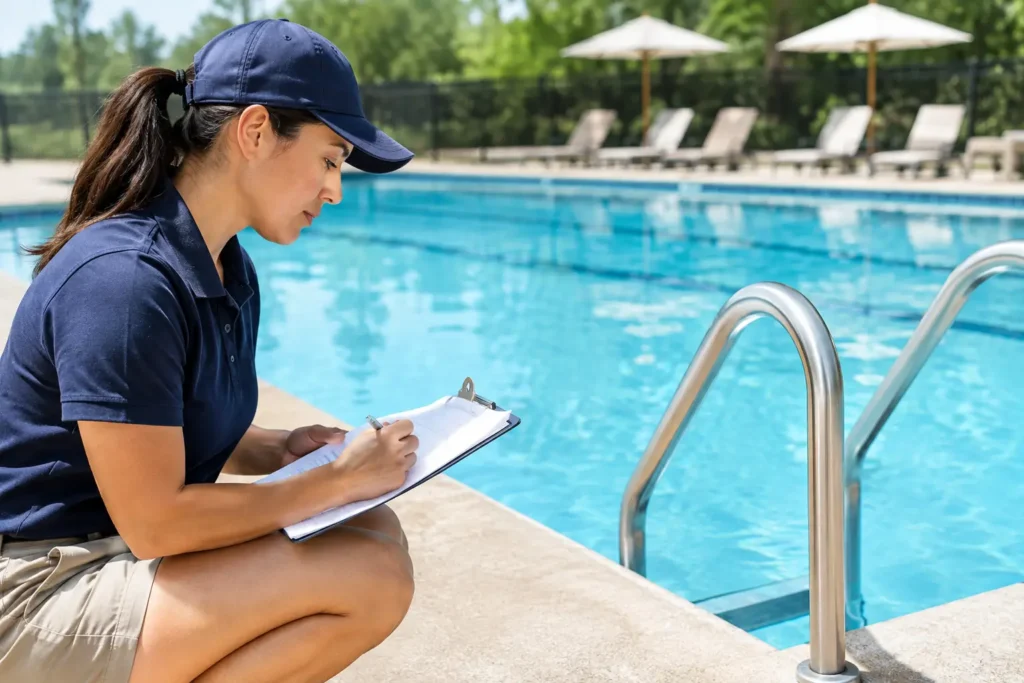
A clear pool can still fail inspection before the first swimmer gets in. The top public pool violations are often found in routine details: an undocumented chlorine reading, a self-closing gate that does not latch, a missing emergency phone, or water that looks clear but does not meet required chemistry. For public and commercial pool operators, these are not minor housekeeping issues. They can lead to corrective orders, closures, liability exposure, and preventable injuries.
Exact inspection requirements vary by state, county, and local health department. Still, the same operational gaps appear repeatedly at apartments, hotels, fitness centers, HOAs, schools, and community facilities. Knowing where inspectors focus helps operators build a practical routine instead of scrambling when an inspection notice arrives.
Why public pool violations happen
Most violations are not caused by a complete lack of effort. They happen when a busy property relies on occasional attention rather than a documented operating system. One employee checks chemical levels, another handles cleaning, and a third responds to equipment alarms. Without clear responsibilities and records, critical tasks get missed.
Seasonal staffing also creates risk. A pool may open with a new maintenance technician who knows how to add chemicals but has not been trained to recognize unsafe water balance, damaged suction covers, or a failed barrier gate. Even experienced operators can fall behind when equipment problems, high bather loads, storms, or staffing shortages disrupt the normal schedule.
The goal is not to memorize every possible code section. It is to understand the conditions that create immediate health and safety concerns, then verify them consistently.
Top public pool violations inspectors commonly find
1. Improper disinfectant and pH levels
Low disinfectant residual is one of the most common and consequential violations. Chlorine or bromine must be maintained within the range required by the local code and appropriate for the pool’s sanitizer system. When residual is too low, the water may not adequately control bacteria, viruses, and other contaminants introduced by swimmers.
High disinfectant readings can also trigger a violation, particularly when they create an exposure concern or signal poor chemical control. pH matters just as much. A pH level outside the acceptable range can reduce chlorine effectiveness, irritate swimmers’ eyes and skin, damage surfaces, and contribute to corrosion or scale.
Operators should test at required intervals using a reliable test kit or approved testing method, record results promptly, and retest after adjustments. Do not assume an automated controller eliminates manual testing. Controllers can drift, probes can foul, and feed systems can run empty or malfunction.
2. Cloudy water or inadequate water clarity
If an operator cannot clearly see the main drain or other designated marker at the deepest part of the pool, the pool may need to close until clarity is restored. This standard exists for a simple reason: lifeguards, staff, and swimmers need to be able to see a distressed person below the surface.
Poor clarity can result from filtration problems, unbalanced chemistry, high bather load, algae, damaged filter media, or insufficient circulation. Adding more chlorine without identifying the cause may not solve the problem. Check filter pressure, flow, pump operation, chemical readings, and backwash or cleaning needs before reopening.
Water can become cloudy quickly after a storm or a busy weekend. A trained operator recognizes that water appearance is not cosmetic. It is a direct safety condition.
3. Missing, incomplete, or inaccurate operational records
A pool log is evidence that the facility is being operated and monitored. Inspectors commonly review chemical readings, water temperature where applicable, maintenance actions, incidents, equipment checks, and closure or reopening decisions. Missing entries can be treated as a violation even when the water tests correctly at the moment of inspection.
A useful log does more than satisfy a paperwork requirement. It allows an operator to spot patterns. Repeated low chlorine readings at the same time of day may point to bather-load demand, a feed issue, or an inadequate testing schedule. A gradual rise in filter pressure can show that the filtration system needs attention before water clarity declines.
Records must reflect actual conditions. Filling in a week of readings after the fact creates a compliance risk and deprives the operator of information needed to make sound decisions.
4. Unsafe barriers, gates, and access controls
Pool barrier requirements are designed to prevent unsupervised access, especially by children. Common violations include gates that do not self-close or self-latch, latch hardware placed incorrectly, gaps under fencing, damaged sections of barrier, and doors that provide unprotected access from a building to the pool area.
Walk the full perimeter regularly, not just the gate used by staff. Check every gate from the outside and inside, confirm that it closes without being pushed, and make sure landscaping, furniture, or stored equipment cannot be used to climb the barrier. A gate that works only when it is slammed is not a reliable safety measure.
Local codes may impose specific barrier heights, spacing, alarm requirements, and access rules. The details vary, so operators should use the requirements enforced by their local jurisdiction rather than relying on assumptions from another property.
5. Missing or nonfunctional safety equipment and signage
Required safety equipment must be present, visible, accessible, and in working order. Depending on the facility and local code, this can include a rescue pole, ring buoy, emergency phone, first-aid supplies, depth markers, no-diving signs, emergency shutoff controls, and posted pool rules.
A ring buoy stored in a locked office is not available during an emergency. A phone with no dial tone or no posted location information may delay emergency response. Signs that are faded, blocked, or covered by decorations are easy to overlook until an inspector or incident reveals the problem.
Assign a staff member to inspect safety items at opening and document the check. Replace weather-damaged equipment promptly. This is a low-cost area of compliance that can have a high consequence when ignored.
6. Drain cover and suction-entrapment failures
Damaged, missing, unsecured, or incompatible drain covers create one of the most serious pool hazards. Suction entrapment can occur when a swimmer becomes trapped against a drain or suction outlet. Public pools and spas must use properly installed, compliant covers and maintain circulation systems in accordance with applicable federal, state, and local requirements.
Operators should never treat a cracked cover, loose screw, or missing grate as a repair that can wait until next week. Close the affected body of water, prevent access, and arrange a qualified repair. It is also critical to know whether the facility’s drain configuration and safety system match the equipment currently installed. A cover alone does not correct every circulation-system hazard.
7. Excessive spa temperature and weak temperature controls
Spas require closer temperature attention than pools. Water that exceeds the maximum temperature allowed by local code can create a serious health risk, especially for children, older adults, pregnant guests, and people with certain medical conditions. A thermostat setting is not proof of actual water temperature.
Verify temperature with an accurate thermometer, maintain the required maximum limit, and make sure temperature controls cannot be easily altered by guests. If the spa overheats, close it until the cause is identified and corrected. Do not rely on temporary dilution with cooler water if the control system continues to drive temperatures upward.
Prevent violations with an operator-led routine
The most effective prevention plan is simple enough to use every day. Before opening, verify water chemistry and clarity, inspect the barrier and safety equipment, and check that pumps, filters, feeders, and controllers are operating normally. Record results while they are fresh, not at the end of a rushed shift.
During the day, retest based on local requirements, bather load, weather, and the type of facility. A lightly used apartment pool and a crowded hotel pool may need very different levels of attention. After heavy use, contamination events, power interruptions, or chemical adjustments, increase monitoring rather than waiting for the next scheduled test.
When a problem is found, respond in the right order: protect swimmers, close the pool or spa when required, correct the underlying cause, retest, document the action, and reopen only when conditions meet the applicable standard. Trying to keep a pool open at all costs is rarely a good business decision.
A CPO course gives operators the technical foundation to make these calls with confidence, from calculating chemical adjustments to recognizing when an equipment condition requires closure or outside service. More importantly, it connects routine tasks to the reason behind them: protecting every person who enters the water.
The next inspection should not be the first time anyone checks the drain covers, gate latches, safety equipment, or logbook. Make those checks part of the normal operating day, and compliance becomes a result of good pool management rather than a last-minute event.