
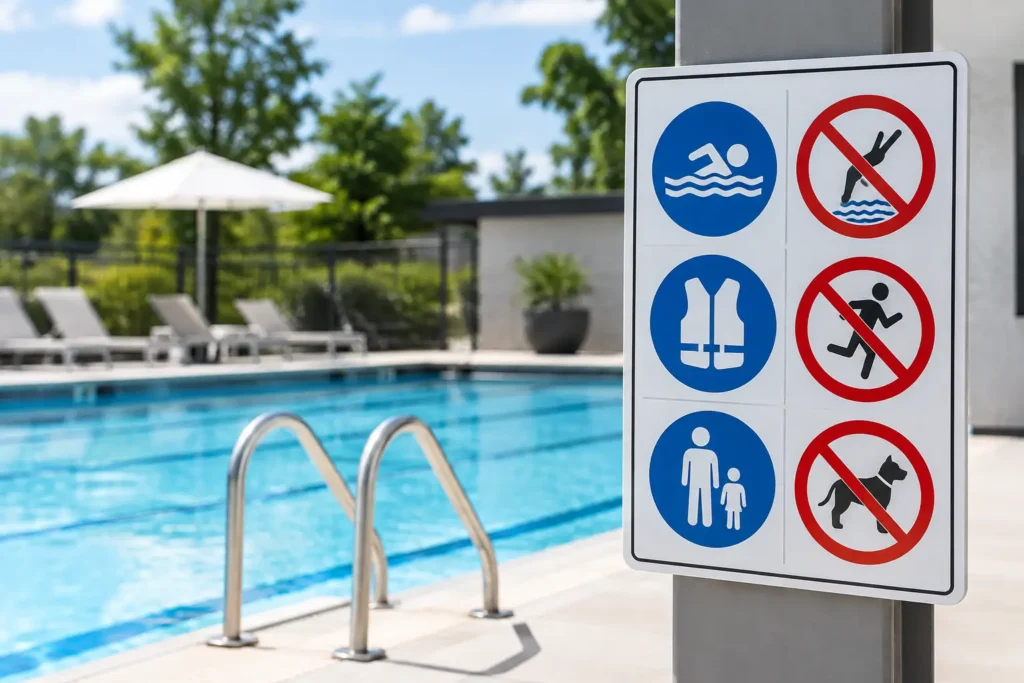
A missing sign can turn a routine pool inspection into a failed inspection, and a poorly placed sign can be nearly as ineffective as no sign at all. Commercial pool signage essentials are not decorative rule boards. They are part of the facility’s safety system, helping guests make safer decisions while showing the health department that operators have communicated required warnings, restrictions, and emergency information.
For apartment communities, hotels, gyms, HOAs, recreation centers, and municipal facilities, the right signage reduces ambiguity at the gate, on the deck, and around the equipment area. The exact requirements vary by state, county, city, and type of facility, so operators should always verify the current rules with their local authority having jurisdiction. Still, the core signage categories are consistent enough to build a reliable compliance process.
Commercial Pool Signage Essentials Start With Local Code
The first rule of signage compliance is simple: do not rely on a generic sign package to satisfy every requirement. A sign that is acceptable at one facility may be incomplete at another because local codes can set specific language, letter height, contrasting-color requirements, placement rules, or multilingual requirements.
Start with the pool and spa regulations adopted by your state and local health department. Then review the most recent inspection report. Inspectors often identify signs that are missing, faded, blocked, mounted too low, or posted in the wrong area. Correcting those items before the next inspection is easier than trying to explain why a required notice was not visible.
Keep a written signage inventory as part of your operating records. List each required sign, its location, its condition, and the date it was checked. This gives a property manager or lead operator a clear way to confirm that a deck renovation, new fence, or replacement gate has not created a visibility problem.
Separate required notices from house rules
Required safety and code notices should be easy to identify and should not be buried beneath optional rules such as “no running” or “please shower first.” House rules are useful, particularly at high-traffic properties, but they do not replace mandated warnings or emergency information.
When every message is crowded onto one oversized board, guests tend to read none of it. Use required wording where the code calls for it, then add facility rules only where they support safe operation and can be read quickly.
The Signs Most Commercial Pools Need
Your jurisdiction determines the final list, but most commercial facilities need signs in several functional categories. Think about what a guest needs to know before entering the water, what they need to know at the water’s edge, and what responders need to know during an emergency.
Entry, access, and supervision signs
The pool entrance is often the best location for posted pool rules, hours of operation, bather-load limits, and any required statement about whether a lifeguard is on duty. If no lifeguard is provided, many jurisdictions require a clearly worded warning. This is especially relevant for hotel, apartment, and fitness-center pools where staff may supervise the facility generally but are not assigned as trained lifeguards.
Access signs may also address gate use, age restrictions, adult supervision, and prohibited activities. Avoid writing a supervision policy that staff cannot reasonably enforce. For example, a rule requiring constant adult supervision is only meaningful if the facility has a process for addressing violations and communicating the expectation to residents or guests.
Depth markers and water-use warnings
Depth markers are among the most visible commercial pool signage essentials because they help swimmers judge the water before entering. They must be durable, legible, and installed where users can see them from both the deck and, where required, inside the pool. Markers should reflect actual measured depths, not assumptions based on an old construction plan.
Diving restrictions deserve special attention. Shallow water, sloped entries, and pools not designed for diving may require “No Diving” or similar warnings in specific locations. A generic safety board on the far side of the deck does not substitute for markings where a person is likely to enter the water. If tile, coping, or deck markers are chipped, obscured, or no longer readable, schedule replacement promptly.
Emergency information and equipment identification
In an emergency, a guest or staff member should not have to search for basic instructions. Many codes require an emergency phone or a clearly identified emergency communication device with 911 instructions, the facility address, and other location details. Check that the posted address matches the exact location emergency responders need, especially at large resorts, campuses, or multifamily properties with multiple pools.
Signage may also identify rescue equipment, first-aid supplies, emergency shutoffs, and the location of the nearest phone. Equipment labels should be kept current when a facility changes the location of a ring buoy, shepherd’s hook, automated external defibrillator, or first-aid kit.
Spa-specific warnings
Spas create risks that differ from those at a swimming pool because of their elevated water temperature. Required spa signage may cover maximum water temperature, time limits, and warnings for pregnant guests, young children, people with medical conditions, and people using alcohol or drugs. The exact wording may be prescribed locally.
Do not treat a spa sign as an optional add-on because the spa is small. A compact vessel can have a high bather load, rapid water-quality changes, and a greater potential for heat-related illness. Keep the warning sign visible from the spa entry, not behind furniture, towels, or a decorative privacy screen.
Placement and Condition Matter as Much as Wording
A compliant message loses value when it is hidden by landscaping, bleached by sun, cracked, or installed behind a locked gate. During routine deck checks, stand where a first-time guest would stand. Can that person find the rules, see the depth before stepping in, and locate emergency equipment without asking for help?
Use durable materials suited to wet, chlorinated environments and direct sunlight. UV-resistant, weather-resistant signs cost more than temporary laminated notices, but repeated replacements can cost more in labor and create gaps in compliance. Temporary notices are appropriate for a short-term hazard or closure, not as a permanent substitute for code-required signs.
Letter size, contrast, and mounting height matter too. Small print may technically fit more information on a sign, but it is difficult to read from a few feet away. Prioritize high contrast and uncomplicated wording. If your community serves guests who commonly speak languages other than English, translated supplementary notices can improve safety, provided they do not alter or replace required wording without local approval.
Build Signage Checks Into Daily Operations
Signage should be checked with the same discipline used for water chemistry, gates, circulation equipment, and safety supplies. A practical approach is to inspect signs during opening rounds, after severe weather, after events, and whenever deck furniture or maintenance work changes the area.
Train staff to report more than missing signs. A sign may be present but still need attention because it is dirty, loose, outdated, partially covered, or contradicted by another notice. For example, an old “pool closed at dusk” sign creates confusion when the posted operating schedule has changed.
When an inspection identifies a deficiency, document the corrective action and the completion date. Photographing the corrected location can be helpful for internal records, particularly when multiple employees or vendors are responsible for the property. For a missing critical emergency or warning sign, consider whether restricting access until the sign is replaced is the safest operational choice.
Common Signage Mistakes That Create Avoidable Risk
The most common mistake is assuming that an online sign bundle covers every local requirement. The next is treating signage as a one-time purchase rather than an item that needs routine inspection. Both mistakes can leave an otherwise well-operated facility exposed during an inspection or incident.
Another issue is posting too much information in the wrong place. A lengthy policy board at the entrance may be useful, but it cannot replace depth markers at the pool edge or a spa warning at the spa entrance. Match each message to the moment when a guest needs it.
Finally, do not let signs become a substitute for active operations. A “No Lifeguard on Duty” sign does not excuse an unsecured gate. A bather-load sign does not manage overcrowding by itself. Signage supports trained staff, good water quality, working safety equipment, and consistent enforcement.
A knowledgeable operator looks at signs the way an inspector or a first-time guest would: Are they current, clear, visible, and appropriate for this exact facility? Build that question into every deck walk. If you need stronger field-ready compliance skills, live CPO training can help connect code awareness, safety practices, and daily pool operation before small oversights become larger problems.