
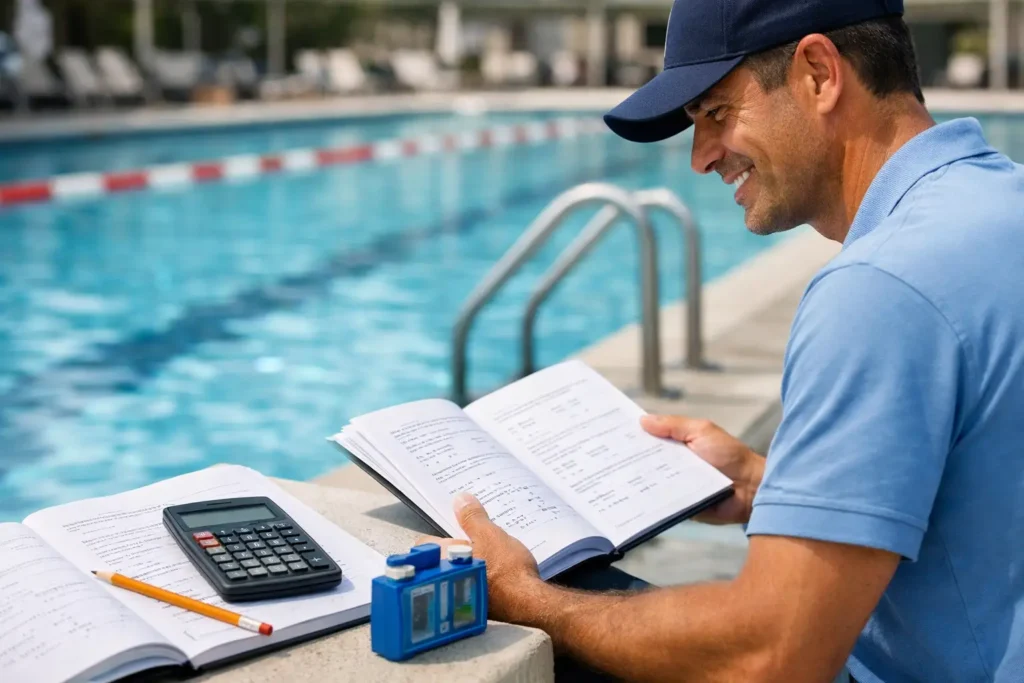
A chemical reading can look simple until you have to decide how much product to add to a 96,000-gallon pool before the facility opens. That is where a pool operator math workbook earns its place. It turns formulas that may feel abstract in class into repeatable decisions you can make with confidence at the equipment pad.
For public and commercial pool operators, math is not a side topic. It supports safe chemical treatment, circulation performance, bather protection, documentation, and compliance. A workbook gives you the repetition needed to understand the numbers behind the routine instead of relying on guesses, old habits, or a label without context.
Why Pool Math Matters on the Job
Pool chemistry and circulation problems rarely announce themselves as a math problem. A cloudy pool may point to poor filtration, insufficient sanitizer, high bather load, poor circulation, or an imbalance in the water. Before you can correct the issue, you need to know the pool volume, the current test result, the target result, and the effect of the chemical product you plan to use.
The same applies to turnover. Health departments and facility policies may require a pool or spa to circulate its full volume within a defined period. If the flow rate is too low, the water may not be receiving the filtration and treatment it needs. If the stated flow rate does not match what the system can actually deliver, the operator needs to recognize that issue before it becomes a compliance concern.
A good workbook makes the connection between calculation and consequence clear. The goal is not to make every operator a mathematician. The goal is to help you make accurate, defensible operating decisions under real working conditions.
What a Pool Operator Math Workbook Should Cover
The most useful workbook problems follow the calculations operators use repeatedly. They should begin with basic unit conversions and build toward scenarios that resemble the work performed at apartments, hotels, fitness centers, HOAs, and community facilities.
Pool and Spa Volume
Every dosage and turnover calculation begins with volume. Rectangular pools, circular pools, kidney-shaped pools, and spas require different approaches. You also need to account for average depth, not simply the deepest point on the pool.
For a rectangular pool, the starting formula is length times width times average depth times 7.5 gallons per cubic foot. For example, a pool that is 50 feet long, 20 feet wide, and has an average depth of 4 feet contains approximately 30,000 gallons:
`50 × 20 × 4 × 7.5 = 30,000 gallons`
That number becomes the foundation for chemical dosing, turnover, and records. A small error in volume can produce a repeated error in treatment, especially in a spa where water volume is much lower and chemical changes occur faster.
Chemical Dosage
Chemical dosage questions teach you to calculate the difference between the current reading and the desired reading, then translate that difference into the amount of a specific product. Product strength matters. One pound of a 65% available chlorine product does not deliver the same available chlorine as one pound of a weaker product.
A workbook should include sanitizer, pH, alkalinity, calcium hardness, cyanuric acid, and shock-treatment examples. It should also reinforce a critical field habit: calculate first, then verify the product label and follow the facility’s chemical handling procedures. Math tells you the treatment target. The label tells you how that product must be applied safely.
Turnover Rate and Flow Rate
Turnover calculations show whether the circulation system is moving enough water through the system within the required time. The basic relationship is straightforward: divide pool volume by the desired turnover time to determine the minimum flow rate.
If a 30,000-gallon pool needs a six-hour turnover, divide 30,000 by 360 minutes. The system needs at least 83.3 gallons per minute. From there, an operator can compare that target with flow-meter readings, pump performance, filter condition, and operational requirements.
This is where workbook practice is especially valuable. It helps operators avoid mixing hours and minutes, a common error that can make an otherwise reasonable answer dramatically wrong.
Dilution and Water Replacement
Some water conditions cannot be corrected by adding another chemical. High cyanuric acid, high total dissolved solids, or other persistent issues may call for partial draining and refilling, subject to local rules and site conditions. Dilution problems require operators to calculate what percentage of water must be replaced to move from the current level toward the target level.
These questions are practical because they encourage a better response than treating symptoms. They also show why accurate test results and complete logs matter before making a costly operational decision.
How to Use the Workbook for Better Retention
Reading formulas once is rarely enough. Pool math becomes more useful when you work a problem, check the answer, identify why an error occurred, and then solve a similar problem without looking at the steps.
Start by writing units beside every number. Gallons, feet, gallons per minute, pounds, ounces, parts per million, and hours are not interchangeable. Unit labels make it easier to spot a misplaced decimal or an incorrect conversion before it affects the final answer.
Next, estimate the range before using a calculator. If a 20,000-gallon pool needs a modest chlorine increase, an answer calling for an extremely large amount of product should prompt a second look. Estimation is not a substitute for the formula, but it is a valuable quality check.
Finally, practice with the same type of facility you operate. A hotel spa creates different calculation challenges than a large community pool. Spas require particular attention because their small volume, warm water, and high use can cause water chemistry to change quickly.
The Difference Between Passing a Test and Operating Safely
CPO coursework includes math because certified operators need to understand the relationship between water conditions, equipment, and corrective action. But the real value of practice is what happens after class. An operator who understands the calculation can explain why a treatment is needed, document the action taken, and recognize when a result does not make sense.
That matters when you are working with a property manager, responding to a health inspection, training another staff member, or deciding whether a pool should remain open. A calculation is only one part of the decision. You must also consider test-kit accuracy, chemical labels, equipment condition, bather load, local code requirements, and the facility’s operating procedures.
For example, a correct dosage calculation does not mean chemicals can be added immediately if the circulation system is down. Likewise, a proper turnover calculation does not prove a filter is functioning effectively. Field-ready operators use math alongside observation, testing, maintenance, and sound judgment.
Common Pool Math Errors to Avoid
The most common errors are usually preventable. Operators may use maximum depth instead of average depth, forget to convert hours to minutes, confuse liquid product volume with product weight, or calculate a dosage based on the wrong pool volume. Rounding too early can also create inaccurate results, particularly with smaller spas.
Another issue is assuming every chemical adjustment should be made at once. Depending on the chemical, water condition, and facility procedures, it may be safer to make a calculated adjustment, allow circulation, retest, and then make a follow-up correction. The workbook calculation gives you a starting point, not permission to skip chemical safety practices.
Keep a written record of the original reading, desired reading, product used, amount added, time of application, and retest result. This supports consistent operations and provides useful evidence that the facility is being actively managed.
Using Math Practice Before Your CPO Course
Students often worry about the math portion of CPO training because they have not used formulas regularly in years. The encouraging news is that pool operator math is practical and formula-based. You do not need advanced algebra. You need to understand what the question is asking, use the correct units, follow the formula, and check your work.
A preparatory workbook can make the live course more productive by familiarizing you with the core calculations before instruction begins. During a live, instructor-led class, that early practice gives you more room to ask useful questions about real facility situations rather than getting stuck on the first conversion.
CPO.Training provides practical resources designed to support that preparation, including a pool math workbook for students who want more time with the numbers. The purpose is simple: help operators arrive ready to learn, pass the course requirements, and apply the material responsibly at their facilities.
A workbook will not replace accurate testing, manufacturer instructions, local regulations, or professional judgment. What it can do is remove uncertainty from the calculations that shape daily pool and spa decisions. Work the problems until the process feels familiar, then bring that same careful approach to every reading, log entry, and corrective action you make.