
A pool can look clear and still fail a health inspection. That is why water chemistry is not simply a maintenance task for commercial operators. It is the daily control system that protects bathers, supports disinfection, prevents equipment damage, and helps keep a facility open.
For property managers, hotel teams, fitness centers, HOAs, and service professionals, the goal is not to chase a perfect-looking test strip. The goal is to understand how each reading affects the others, respond in the right order, and document work in a way that supports safe, code-compliant operation.
Water Chemistry Is a Balance, Not a Single Reading
Pool water changes constantly. Bather load adds sweat, body oils, cosmetics, and nitrogen compounds. Sunlight consumes unstabilized chlorine. Rainwater can dilute sanitizer and alkalinity. Fresh fill water may introduce calcium, metals, or a very different pH.
Because these forces act together, one chemical adjustment can affect several readings. For example, lowering pH may improve sanitizer effectiveness, but it can also lower total alkalinity and increase the risk of corrosive water if taken too far. Adding a chlorine product may raise or lower pH depending on its formulation. The right response depends on the full test result, the pool type, local code requirements, and the product label.
A qualified operator does not treat water chemistry as a set of unrelated numbers. They look for the cause behind the number. That approach reduces chemical waste, avoids overcorrection, and creates more reliable operating conditions.
The Readings That Drive Safe Pool Operation
Free chlorine and combined chlorine
Free chlorine is the sanitizer available to kill or inactivate contaminants. It is the reading most operators watch first, but its value only makes sense when considered with pH, stabilizer level, bather load, and the facility’s required minimum disinfectant residual.
Combined chlorine forms when free chlorine reacts with contaminants. A noticeable chloramine odor, eye irritation, or poor water quality can signal a combined chlorine problem, although odor alone is not a complete diagnosis. High combined chlorine commonly points to inadequate oxidation, heavy use, poor circulation, or insufficient fresh-water replacement. Follow applicable code, product instructions, and facility procedures when determining whether breakpoint chlorination, partial draining, or another response is needed.
Do not confuse a strong chemical smell with a clean pool. A properly managed pool should have an appropriate disinfectant residual without an overpowering chloramine odor.
pH and total alkalinity
pH measures whether water is acidic or basic. It directly affects swimmer comfort, corrosion potential, scale formation, and chlorine performance. When pH rises too high, chlorine becomes less effective and cloudy water or scale may become more likely. When it drops too low, the water can become corrosive to surfaces, heaters, metal components, and equipment.
Total alkalinity helps resist sudden changes in pH. Think of it as pH’s shock absorber. If alkalinity is too low, pH may swing from one test to the next. If it is too high, pH can become difficult to lower and scale risk may increase.
The common mistake is adjusting both aggressively at the same time. A better method is to identify which reading is most out of range, make a measured correction, allow proper circulation, and retest. This is especially necessary when source water, treatment products, or weather conditions are contributing to the imbalance.
Calcium hardness
Calcium hardness matters because water seeks balance with the materials around it. Water that is too low in calcium can be aggressive, particularly in plaster pools, and may contribute to etching or damage. Water that is too high in calcium increases the likelihood of scale on surfaces, heaters, filters, and salt cell components.
Hardness targets vary by pool finish, equipment, local water conditions, and code. A vinyl-lined pool and a plaster pool do not have the same risk profile. Operators should test source water before adding large volumes and account for evaporation, which leaves calcium behind and gradually concentrates it.
Cyanuric acid and sunlight
Cyanuric acid, often called stabilizer or conditioner, protects chlorine from rapid destruction by sunlight in outdoor pools. It can be useful, but it is not a chemical to add automatically. Too little may leave outdoor chlorine vulnerable to ultraviolet loss. Too much can reduce chlorine’s activity and complicate effective sanitation.
Unlike free chlorine, cyanuric acid does not disappear quickly through normal use. It tends to accumulate when stabilized chlorine products are used repeatedly. If the level becomes excessive, dilution with fresh water may be the practical correction. Indoor pools and spas may have different needs, and some jurisdictions restrict or prohibit cyanuric acid in certain facilities. Always follow local requirements.
Test at the Right Times and Use Reliable Methods
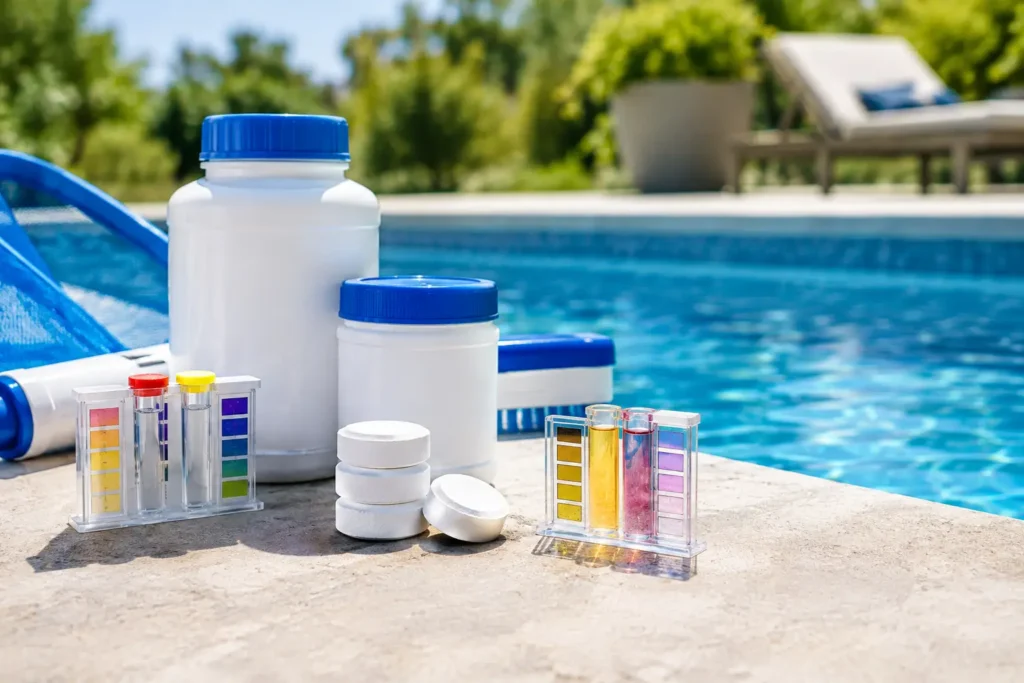
A water test is only as useful as the sample and method behind it. Collect water away from return inlets, skimmers, and chemical feed points. Take the sample at the recommended depth, use clean testing equipment, and follow the test kit instructions precisely. Expired reagents, contaminated comparators, and hurried color matching can produce readings that lead to bad treatment decisions.
Testing frequency should meet local code and increase with conditions. A busy Saturday at a community pool requires more attention than a quiet weekday morning. After a storm, fecal incident, equipment outage, chemical adjustment, or unusually high bather load, operators should test and document more often.
Digital controllers and automated chemical feeders are valuable tools, but they do not replace manual verification. Sensors drift, feed lines clog, probes foul, and calibration can be missed. Manual testing gives the operator a direct check on what is actually happening in the water.
Correct Problems in the Right Sequence
When several readings are off, adding a little of everything is rarely the answer. That approach can create conflicting reactions and make the original issue harder to diagnose. Instead, pause, verify the results, inspect the circulation system, and make corrections methodically.
Start by confirming disinfectant residual and whether the pool is safe to remain open under local rules. Next, review pH and total alkalinity, then evaluate calcium hardness, cyanuric acid, temperature, and other site-specific factors. Check the pump, filter pressure, flow, feeder operation, chemical inventory, and recent log entries before assuming the issue is purely chemical.
After adding any chemical, circulate the water for the required period and retest before making another major adjustment. Never mix products together, add water to chemical, or combine incompatible chlorine products in the same container. Chemical handling procedures, personal protective equipment, storage separation, and product labels are part of water management, not separate concerns.
Why Logs Matter During Inspections and Incidents
A complete operating log shows more than numbers. It records that the facility has a consistent process for testing, responding, and maintaining equipment. Depending on local requirements, records may include disinfectant and pH readings, time of testing, chemical additions, water temperature, incidents, corrective actions, and operator initials.
Good documentation is especially useful when a reading changes unexpectedly. If free chlorine falls every afternoon, the log can help identify a pattern tied to bather load, sunlight, feeder timing, or circulation. If pH rises after a product change, the record gives the operator evidence to investigate instead of guessing.
Logs also support communication. A morning operator, maintenance supervisor, outside service company, and health inspector should be able to see what occurred, what was corrected, and what still needs attention.
Water Chemistry Training Builds Better Decisions
Chemical charts and test kits are useful, but they cannot replace sound judgment. Public and commercial pool operators need to understand why readings move, how chemistry affects equipment and bathers, and when a condition requires closure or escalation.
That is the practical value of CPO training: translating test results, calculations, safety procedures, and code awareness into field-ready decisions. The strongest operators do not memorize a single set of numbers and apply it everywhere. They understand their facility, follow the governing requirements, use reliable testing, and document each step.
The next time a pool looks clear but the readings are questionable, trust the test, review the system, and correct the cause before it becomes a safety issue or a closure.