
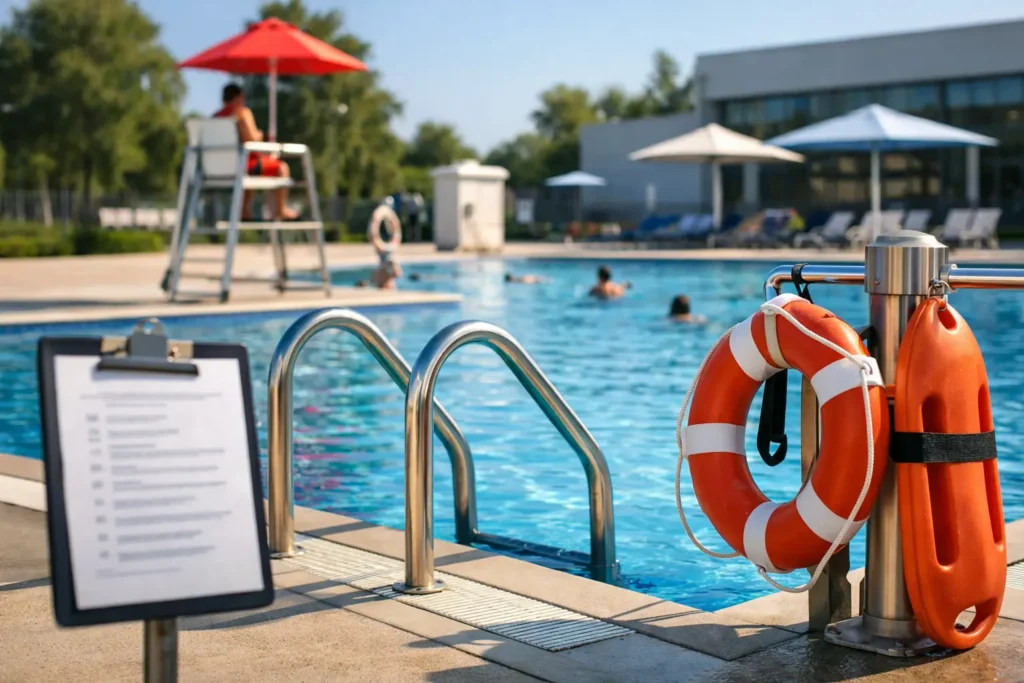
A health inspector rarely sees a pool the way an operator sees it. You may see clear water, a functioning pump, and a clean deck. The inspector also sees whether required safety equipment is present, whether the gate latches correctly, whether records prove consistent testing, and whether the facility meets local pool code requirements. A pool can look ready for guests and still fail an inspection.
For public and commercial facilities, code compliance is an operating system, not a once-a-year checklist. The exact rules depend on where your pool or spa is located, but the core responsibilities are consistent: protect bathers, maintain safe water, control access, document your work, and correct hazards before they become incidents.
Why Pool Code Requirements Vary
There is no single pool code that applies identically to every public pool in the United States. State and local health departments generally adopt and enforce their own regulations. A county, city, or special district may also impose requirements that go beyond the state baseline.
Federal rules can apply in specific areas. The Virginia Graeme Baker Pool and Spa Safety Act addresses drain-cover and suction-entrapment safety. The Americans with Disabilities Act can affect accessible entry requirements at public accommodations. Meanwhile, the Model Aquatic Health Code is a science-based resource that many jurisdictions use when updating regulations, but it is not automatically enforceable law.
That distinction matters. A recommendation in an industry guide is not necessarily a local requirement, and a national credential does not replace a permit, inspection, or local operator requirement. Before opening a facility or making a major repair, confirm the standards enforced by your local authority having jurisdiction, typically the health department or building department.
The Core Areas Inspectors Review
Although wording varies by jurisdiction, most public-pool regulations address the same operational areas. Treat these as the categories your team should review routinely, rather than waiting for an inspection notice.
Water quality and circulation
Disinfection and water balance are central to public health compliance. Codes commonly establish acceptable ranges for disinfectant residual, pH, water clarity, cyanuric acid, and sometimes total alkalinity, calcium hardness, and combined chlorine. They may also specify how often water must be tested and what records must be kept.
The acceptable chemical range is only part of the picture. Inspectors may evaluate whether the circulation system is operating as designed, whether flow is adequate, whether filters are maintained, and whether the water is clear enough to see the main drain or other designated marker. If water clarity is poor, closing the pool is often the correct action even if a test result appears close to range.
Spas deserve separate attention. Higher water temperatures accelerate disinfectant demand and can create conditions that change quickly. A spa should not be managed as a small swimming pool. Its testing frequency, bather-load limits, temperature controls, and response procedures may be more restrictive.
Barriers, gates, and controlled access
A compliant barrier prevents unsupervised access, especially by young children. Regulations may cover fence height, gaps below and between barrier components, climbable features, gate swing direction, self-closing hinges, self-latching mechanisms, and latch height.
This is an area where seemingly minor changes create violations. A landscaping feature, outdoor furniture, storage bin, or service cart placed next to a fence can become a climbable object. A gate that closes when tested slowly may fail to latch when released from a wider position. Check gates in real operating conditions, not just by appearance.
When a pool is closed, access controls matter just as much as they do during open hours. A locked gate, secure equipment room, and clear closure procedures help prevent an after-hours accident from becoming a major liability event.
Safety equipment and required signage
Public pools typically need designated emergency and rescue equipment, such as a reaching pole and ring buoy with line. Exact dimensions, placement, and quantity are local-code questions, so equipment should be verified against the applicable rule rather than purchased based on a generic list.
Required signs often address pool rules, emergency contact information, depth markings, no-diving areas, bather restrictions, and spa warnings. Some jurisdictions require specific language, lettering size, location, or durable construction. A faded sign or one blocked by furniture can be treated the same as a missing sign.
Emergency equipment must be accessible and usable. Do not lock it in a storage room, hang it behind stacked chairs, or allow it to become a decorative fixture. Staff should know where every item is located and how to use it.
Drain safety and mechanical protection
Suction entrapment prevention is a life-safety responsibility. Pool and spa operators should verify that drain covers are intact, properly secured, and appropriate for the installed system. A broken, missing, loose, or expired cover calls for immediate action. Depending on the system and local rules, that may mean closing the affected body of water until the issue is corrected.
Mechanical rooms also receive attention. Chemical containers should be labeled and stored safely, incompatible products must be separated, and ventilation must function properly. Equipment leaks, unsecured electrical components, inaccessible shutoffs, and poor housekeeping can lead to violations or injuries even when the water itself is balanced.
Records Turn Good Work Into Proof
A logbook is not busywork. It is the facility’s evidence that staff tested the water, responded to abnormal conditions, completed inspections, and maintained equipment consistently.
Most facilities should document water-test results, times of testing, chemical additions, pool and spa closures, corrective actions, filter maintenance, incidents, and inspection findings. Your jurisdiction may set a required retention period and may require specific information in each entry.
Write entries so another trained operator can understand what happened. “Added chemicals” is weak documentation. A better entry records the test result, product used, amount added, time, follow-up result, and any temporary closure. This level of detail helps with inspections, troubleshooting, staff handoffs, and incident response.
Digital logs can work well, but only if staff complete them consistently and management can retrieve records promptly. Paper logs remain practical for many facilities. The better choice is the one your team will use accurately every day.
Build a Compliance Routine That Works
The best compliance programs fit into normal operations. A property manager should not have to rely on memory, and a maintenance technician should not have to guess which issue is urgent.
Start each day with a visual safety walk. Check the barrier and gates, deck conditions, rescue equipment, signage visibility, water clarity, water level, and obvious mechanical concerns. Test and log water according to the required schedule. If readings are outside the approved range, follow the facility’s written corrective-action procedure and close the pool or spa when conditions require it.
Each week, review equipment-room housekeeping, chemical inventory, filter pressure or flow trends, and any recurring water-quality issue. A repeated pH swing or ongoing loss of disinfectant is not just a chemistry annoyance. It may point to bather-load pressure, feeder problems, poor circulation, or a developing equipment failure.
Monthly, have a manager or qualified operator review logs, training needs, open repairs, and changes to local requirements. Seasonal opening and closing should include a more detailed inspection of barriers, drain covers, depth markers, lights, circulation equipment, and emergency procedures.
Certification Supports Compliance, but Does Not Replace Local Rules
Many jurisdictions require a certified pool operator for certain public or commercial facilities, while others require trained personnel without naming a specific credential. Even where certification is not mandated, a nationally recognized CPO credential gives operators the practical framework to manage water chemistry, circulation, safety equipment, records, and problem response.
Training is especially valuable when the person responsible for the pool also has other duties. Hotel maintenance teams, apartment staff, HOA managers, and fitness-center personnel often need to make safe decisions quickly without a full-time aquatics department behind them. A live, instructor-led course helps connect technical concepts to the conditions operators face at the equipment pad and on the deck.
CPO.Training provides that instruction in a live virtual format, helping working professionals earn certification without travel or extended time away from the facility. Still, every certified operator should keep current copies of the regulations that govern their own site.
Common Questions About Pool Code Requirements
Does a CPO certification guarantee a pool will pass inspection?
No. Certification demonstrates operator knowledge, but inspection results depend on the facility’s current condition and the rules enforced locally. A certified operator is better prepared to identify and correct problems before an inspection.
Can a pool stay open if one chemical reading is out of range?
It depends on the reading, the degree of deviation, the cause, and local regulations. Disinfectant loss, poor water clarity, unsafe pH, or a mechanical failure may require immediate closure. Follow your jurisdiction’s closure criteria rather than relying on convenience or guest expectations.
Who is responsible for compliance at an apartment or hotel pool?
The legal responsibility usually rests with the owner or operating entity, but day-to-day duties may be assigned to a manager, maintenance employee, service company, or certified operator. Clear written assignments prevent critical tasks from being missed.
A well-run pool is not defined by how it looks at noon. It is defined by the checks completed before guests arrive, the records behind every reading, and the willingness to close the water when safety requires it.