
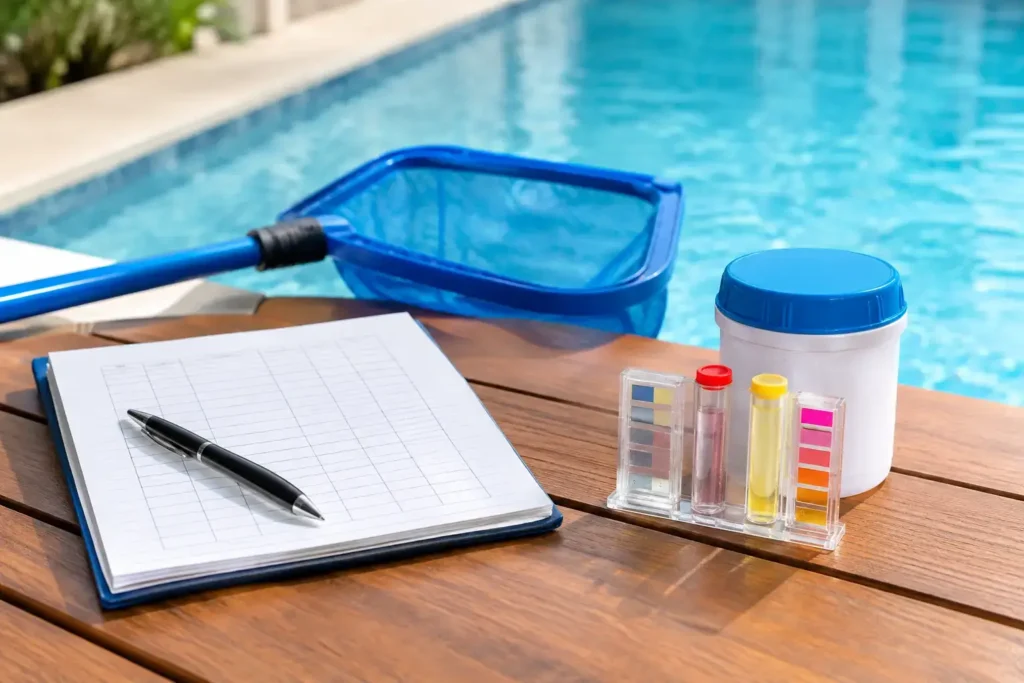
A health inspector should be able to open your pool logbook and understand the day’s operating conditions in less than a minute. More importantly, your staff should be able to use it to catch a developing water-quality or equipment problem before it becomes a closure, complaint, or injury. That is why the essential pool logbook fields are more than paperwork. They are the operating record for a public or commercial pool or spa.
Logbook requirements vary by state, county, and local health department, so the approved form and testing frequency at your facility always control. Still, the strongest logs have the same purpose: document water quality, equipment status, corrective action, and the person responsible for the entry. A complete log creates accountability and gives operators the information needed to make sound decisions during every shift.
Why a pool logbook matters
A logbook documents that water was tested, chemical readings were reviewed, and problems received attention. If free chlorine falls below the required range, a clear record helps show when staff identified the issue, what they did, and when they confirmed the correction.
That record has value well beyond an inspection. Shift changes are smoother when the incoming operator can see that a feeder was adjusted, a filter was backwashed, or a pool was temporarily closed for contamination. For managers, consistent entries can reveal patterns: frequent pH drift, unusually high chlorine demand, recurring low flow, or a heater that is becoming unreliable.
A blank line, a guessed number, or a checkbox without an actual measurement does not provide that protection. Logs should reflect real tests performed at the required time using a reliable test method.
Essential pool logbook fields for daily operation
Your local form may combine some of these items or require additional information. The following fields form a practical baseline for most public and commercial pool and spa operations.
Date, time, and facility identification
Every entry needs a date and the time of the test. This may sound basic, but it establishes whether required testing intervals were met. “Morning” or “afternoon” is not a substitute for a time when the health department requires readings at specific intervals.
Identify the body of water being tested as well. A property with a main pool, wading pool, therapy pool, and spa needs separate, unmistakable entries. Water chemistry in one vessel does not represent another. Include the facility name or location on each log page, particularly when staff manage multiple properties.
Operator name or initials
The log should identify who performed the test and made the entry. Initials may be acceptable where local rules allow them, but they need to correspond to a known staff member. This makes follow-up possible when a reading is outside range or an entry needs clarification.
The goal is not to assign blame. It is to ensure that the operator who observed a condition can explain what happened and that managers can confirm staff are following the operating plan.
Disinfectant readings
For most pools, this means recording free chlorine and, where required, total chlorine. The difference between total chlorine and free chlorine helps identify combined chlorine, which can signal a need for corrective treatment or a closer review of bather load and circulation.
Facilities using bromine or another approved sanitizer should record the applicable disinfectant residual. Write the numerical result, not simply “OK.” An actual number shows whether the water was comfortably within range or barely met the minimum.
Many jurisdictions require more frequent disinfectant testing for spas because warm water, heavy use, and aeration can change conditions quickly. Do not assume the pool testing schedule applies to the spa.
pH and water balance readings
pH belongs on every routine log because it affects sanitizer performance, swimmer comfort, corrosion, and scale formation. Record the measured value and respond when it falls outside the operating range established by your code or operating procedures.
Depending on local requirements and the type of facility, your log may also include total alkalinity, calcium hardness, cyanuric acid, water temperature, and total dissolved solids. These values are not always tested at the same frequency as disinfectant and pH. A daily line may therefore include only the readings required daily, with a separate weekly or monthly water-balance section.
This is one area where operators should avoid over-documenting in a way that encourages rushed testing. It is better to use a clear schedule for each parameter than to fill every field every day without completing the test correctly.
Water clarity and visual conditions
A chemical test alone does not prove that a pool is safe to use. The log should capture a visual check of water clarity. Can the operator clearly see the main drain or other required bottom markers from the deck? Is there cloudiness, foam, algae, staining, or an unusual odor?
A simple “clear” entry can work if the log defines the inspection standard. When conditions are abnormal, document the observation in plain language. For example: “Deep end drain not clearly visible at 2:15 p.m.; pool closed, circulation checked.” Specific notes are far more useful than a vague comment such as “water looked bad.”
Equipment operation and circulation status
The essential pool logbook fields should show whether the circulation and disinfection systems were functioning when the water was tested. Depending on your equipment and local requirements, this can include filter pressure, flow rate, pump operation, chemical feeder status, controller readings, and heater operation.
Not every facility needs a detailed equipment reading with every chemistry test. It depends on the health code, equipment design, and your written operating procedures. But operators should record enough information to identify a change from normal conditions. A filter pressure reading, for example, becomes useful when it is compared with the clean-filter baseline.
If an alarm activates, a pump loses prime, a feeder is empty, or the flow meter indicates inadequate circulation, record it. Those details explain why water chemistry may have shifted and support maintenance decisions.
Chemicals added and dosage information
When staff add chemicals, record what was added, how much, and when. This is particularly valuable after a large adjustment, a shock treatment, or an incident that requires special procedures.
Use the product name or chemical type and the amount in a consistent unit, such as pounds, gallons, or ounces. “Added chlorine” is not enough information for the next operator to understand the treatment. Accurate dosage entries also help identify excess chemical use, calibration issues, or recurring demand problems.
Never treat the log as a substitute for chemical safety practices. Staff still need to follow label directions, storage procedures, personal protective equipment requirements, and facility protocols.
Corrective action and closure documentation
This field is where a good logbook becomes a useful operating tool. When a reading is out of range, record the action taken, the time it occurred, and the retest result. If the pool closed, document the closure and reopening time.
A complete entry might read: “Free chlorine 0.6 ppm at 10:00 a.m. Pool closed. Adjusted feeder and added sanitizer per procedure. Retest at 10:40 a.m.: 2.0 ppm. Pool reopened.” The exact acceptable values and procedures depend on your jurisdiction, but the documentation pattern remains the same: condition, response, verification.
For fecal, vomit, blood, chemical spill, or other contamination incidents, use the incident procedures required by your local health department. The regular log may reference a separate incident report when more detail is needed.
Build a log staff can complete accurately
The best form is clear enough to use during a busy shift and detailed enough to stand up to an inspection. Arrange fields in the order staff perform the work: identify the vessel, test water, inspect conditions, check equipment, record action, and sign the entry.
Use a short written routine for every shift:
- Test each pool and spa at the required intervals.
- Enter actual readings immediately after testing.
- Compare results with your required operating ranges.
- Correct abnormal conditions and document the response.
- Retest when required before reopening or returning to normal operation.
Train all assigned staff on the same logbook process. A manager cannot rely on a form that only one experienced operator understands. During live CPO instruction, operators learn how water chemistry, circulation, safety procedures, and documentation work together in real facility conditions.
Keep records useful, not merely complete
Store completed logs for the retention period required by your jurisdiction and keep them accessible to inspectors and facility management. Paper logs can work well when entries are legible and protected from water damage. Digital systems can simplify storage and trend review, but only if staff can enter information promptly and the records remain available during an inspection.
Review logs regularly, not just when an inspector arrives. A five-minute weekly review can uncover a feeder that repeatedly runs low, a spa with unstable pH, or a recurring clarity issue after high-use weekends. That is the practical value of consistent documentation: it turns daily readings into early warnings.
A well-kept logbook will not operate the pool for you, but it gives every operator a clearer picture of what the water and equipment are telling them. When the next abnormal reading appears, the record should help your team act with confidence, document the correction, and keep swimmers safe.